

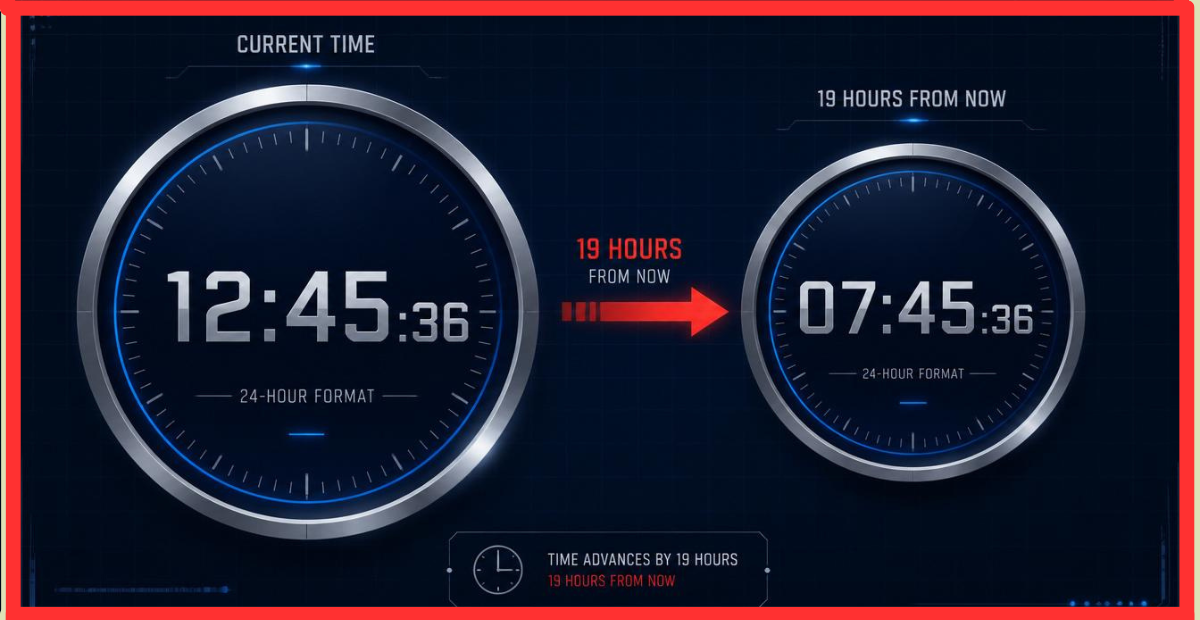
If you’ve ever glanced at a clock, sighed a tiny sigh, and whispered, “Wait… what time is 19 hours from now?” then welcome, you’re in surprisingly good company.
It sounds like one of those questions that pops into your head while setting an alarm before bed, planning a long flight, scheduling an online meeting, or counting down to something that actually matters.
Funny enough, time has this odd little habit of feeling stretchy. Five minutes in a queue can feel like a whole season, yet nineteen hours somehow disappears before you even notice it.
Let’s imagine the current time is 11:07 PM on Wednesday, July 1, 2026, in the GMT-7 time zone. If you simply add 19 hours, the future time becomes 6:07 PM on the following day. That’s the beauty of time calculation it follows rules even when our brains don’t always wanna cooperate.
| Current Time | Add | Result |
|---|---|---|
| 21:23 (9:23 PM) | +19 hours | 16:23 (4:23 PM) tomorrow |
Still, there’s more to this than adding numbers. Understanding hours from now, time difference, and simple time arithmetic can save you from missed meetings, forgotten appointments, or texting someone at 3 AM by mistake. Time is funny like that. It never waits, but it does leave clues.
What Time Is 19 Hours From Now?
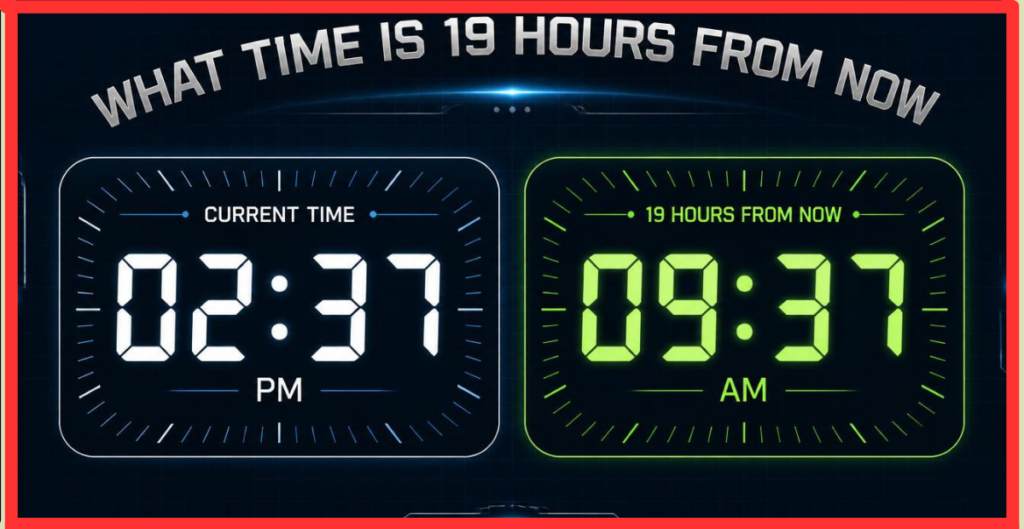
Let’s answer the question first before wandering into the fun bits.
If the current clock time is 11:07 PM on Wednesday, July 1, 2026 (GMT-7), then 19 hours from now is:
- 6:07 PM
- The following day
- Still in the same GMT-7 time zone unless you travel elsewhere
The math is refreshingly simple.
Start with 11:07 PM.
Move ahead 12 hours and you reach 11:07 AM.
Add the remaining 7 hours.
You arrive at 6:07 PM.
That is exactly how a basic future time calculator, hours from now calculator, or clock calculator performs the calculation behind the scenes.
Understanding the Simple Time Addition Formula
People often imagine time conversion is complicated. Honestly, it mostly isn’t.
A straightforward time addition formula looks like this:
Future Time = Current Time + Number of Hours
In our example:
- Current Time = 11:07 PM
- Hours Added = 19
- Result = 6:07 PM the next day
When the total crosses midnight, the calendar advances automatically. That’s where many people get confused, but it’s actully very normal.
Whether you’re using a notebook, your phone, or an online calculator, the principle never changes.
Why Someone Might Need to Calculate 19 Hours From Now
You’d be surprised how often people search for this exact thing.
Imagine you’re:
- Scheduling a Zoom meeting with someone overseas.
- Waiting exactly nineteen hours before taking another action.
- Planning a road trip.
- Tracking shipping estimates.
- Timing medication (always follow professional medical advice).
- Counting down until a sporting event.
- Organizing work shifts.
- Preparing for an online exam.
- Planning social media posts.
- Simply satisfying your own curiosity.
Every one of those situations depends on accurate clock calculation and understanding the time interval involved.
Sometimes the smallest calculations prevent the biggest headaches.
Breaking Down the 19-Hour Duration
Nineteen hours sounds short until someone asks how long that actually is.
Here’s the complete breakdown.
| Duration | Equivalent |
|---|---|
| 19 hours | 19 hours |
| Minutes | 1,140 minutes |
| Seconds | 68,400 seconds |
| Milliseconds | 68,400,000 milliseconds |
Those numbers may seem huge, but they’re simply different ways of expressing the same duration.
Developers, engineers, scientists, and software systems frequently convert time into seconds or milliseconds because computers think in much smaller chunks than humans do.
Converting Hours Into Other Units
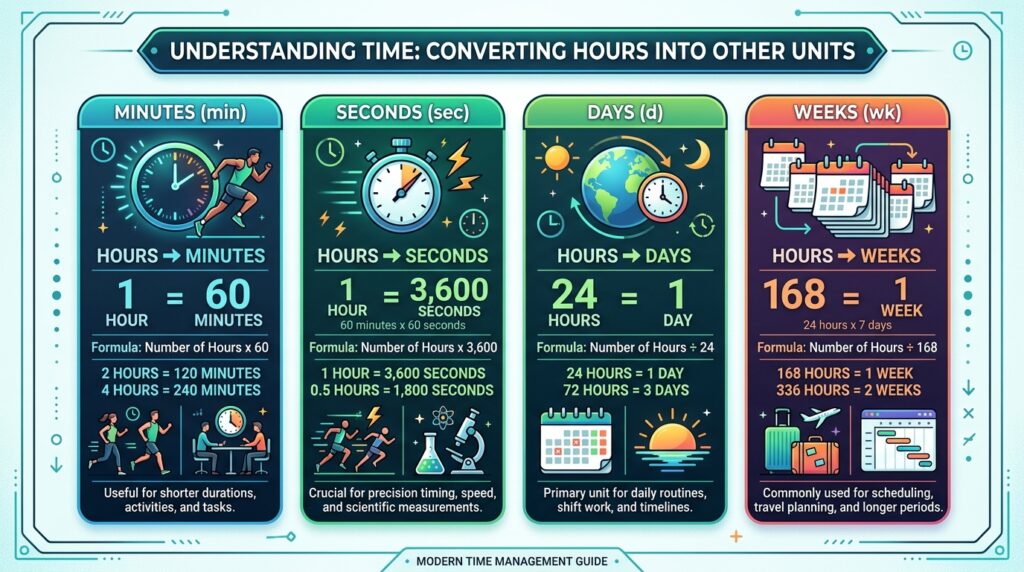
Let’s make the conversion even easier.
Hours to Minutes
Multiply by 60.
19 × 60 = 1,140 minutes
Hours to Seconds
Multiply minutes by 60 again.
1,140 × 60 = 68,400 seconds
Hours to Milliseconds
Multiply seconds by 1,000.
68,400 × 1,000 = 68,400,000 milliseconds
That’s the complete hour conversion process.
Nothing magical just steady multiplication.
What Happens When You Cross Midnight?
Crossing midnight is where many calculations feel slightly weird.
Suppose it’s:
- 10 PM
- Add 20 hours
- You reach 6 PM tomorrow.
Or maybe:
- 11 PM
- Add 21 hours
- You reach 8 PM the following day.
The calendar quietly changes while the clock keeps ticking.
Once you understand midnight as simply another checkpoint rather than a stopping point, future time calculation becomes much easier.
Comparing 19 Hours With Nearby Time Durations
Sometimes it helps to compare.
| Hours Added | Result (Starting at 11:07 PM) |
| 19 hours | 6:07 PM |
| 20 hours | 7:07 PM |
| 21 hours | 8:07 PM |
| 22 hours | 9:07 PM |
| 23 hours | 10:07 PM |
| 24 hours | 11:07 PM next day |
Notice how 24 hours simply returns you to the same clock reading on the next calendar day.
That’s why a full day always feels oddly satisfying.
12-Hour Clock vs 24-Hour Clock
Different countries display time differently.
The familiar 12-hour clock uses:
- AM
- PM
Meanwhile, the 24-hour format would show:
- 18:07 instead of 6:07 PM
- 23:07 instead of 11:07 PM
Neither system is better.
They’re simply different ways of writing the exact same moment.
Understanding both formats helps avoid confusion during clock conversion.
Morning, Afternoon, Noon, and Midnight

People occasionally mix these up.
Here’s a quick refresher.
- Morning generally begins after midnight.
- Noon occurs at exactly 12:00 PM.
- Afternoon starts after noon.
- Evening follows later.
- Midnight begins the next calendar day.
Knowing these reference points makes calculate future clock time questions much less confusing.
What Time Was It 19 Hours Ago?
While people often ask about the future, the opposite question appears almost as frequently.
Instead of time addition, you’d use time subtraction.
The formula becomes:
Past Time = Current Time − Number of Hours
This is exactly how an hours ago calculator works.
Whether moving forward or backward, the process follows identical mathematical rules.That’s why many date and time calculator tools include both future and past options.
Using an Online Time Calculator
An online time calculator removes all the mental work.
Simply:
- Enter the current time
- Enter the number of hours
- Choose whether to add or subtract
- View the result instantly
A good future time calculator online also accounts for date changes automatically.
It’s especially useful when working across multiple time zones.
Understanding Time Zones
Our example uses GMT-7.
If someone in another region performs the exact same calculation, their clock reading may differ because their local time starts differently.
This is why timezone calculation matters during:
- International meetings
- Airline schedules
- Remote work
- Global conferences
- Online gaming events
The math stays identical.
Only the starting point changes.
Real-Life Examples of Adding 19 Hours
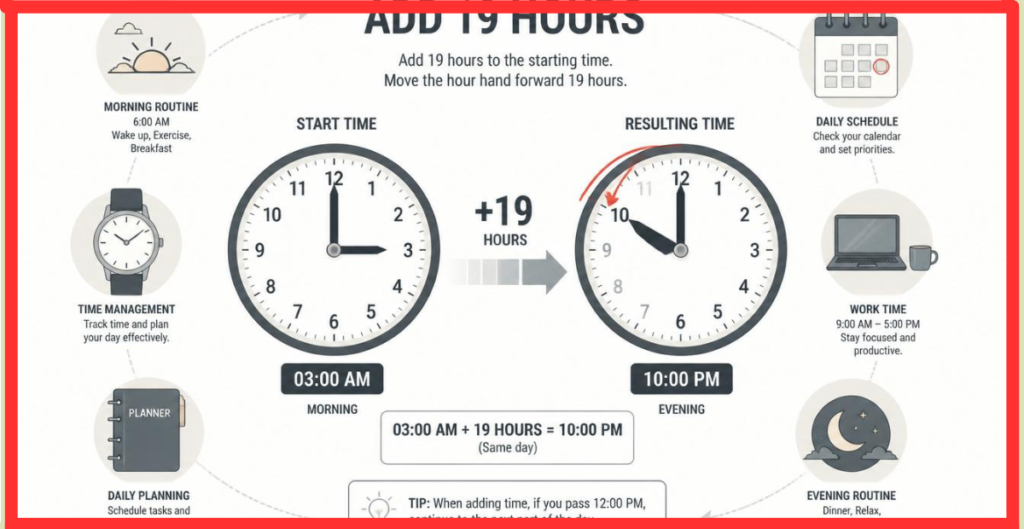
Let’s make things practical.
Imagine you finish work at 4 PM.
Nineteen hours later?
You’re at 11 AM tomorrow.
Suppose your flight leaves at 7 AM.
Nineteen hours afterward?
It’s 2 AM the following day.
Or maybe you start baking bread dough late at night—okay, nineteen hours is probably too long for bread, but stranger recipes have existed. Someone somewhere has probably forgotten dough that long. Happens.
These tiny examples show how calculate time difference becomes useful in everyday routines.
Why Human Brains Struggle With Time Arithmetic
Oddly enough, humans are excellent at storytelling and surprisingly clumsy at simple clock calculation.
Ask someone:
“What comes after 19 hours?”
Many people instinctively begin counting on fingers, then pause halfway through because midnight sneaks into the equation.
That’s completely normal.
Unlike ordinary numbers, clocks wrap around after 12 or 24 hours.
That looping nature makes time arithmetic feel trickier than it actually is.
Helpful Tips for Accurate Hour Calculations
Here are a few habits worth keeping.
- Always confirm the current clock first.
- Double-check whether you’re using AM or PM.
- Remember that passing midnight changes the date.
- Use the same time notation throughout your calculation.
- Consider local GMT offsets when traveling.
- Verify appointments with an accurate time converter if multiple countries are involved.
- When in doubt, use a trusted duration calculator or date calculator.
Tiny checks prevent surprisingly large mistakes.
Frequently Asked Questions
What time will it be in 19 hours?
If it’s 11:07 PM on Wednesday, July 1, 2026 (GMT-7), then nineteen hours later will be 6:07 PM the following day.
How do I calculate future time?
Simply add the desired number of hours to the present time while adjusting for midnight whenever necessary.
Is 19 hours almost a full day?
Pretty much.
A full day contains 24 hours, so 19 hour duration is just five hours short of an entire day.
How many minutes are in 19 hours?
Exactly 1,140 minutes.
How many seconds are in 19 hours?
Exactly 68,400 seconds.
How many milliseconds are in 19 hours?
Exactly 68,400,000 milliseconds.
Can I subtract 19 hours instead?
Absolutely.
Simply use time subtraction instead of addition, or rely on an hours ago calculator.
Frequently Asked Question
19 hours from now
Nineteen hours from now, the time will be 11:07 PM if the current time is 4:07 AM. Simply add 19 hours to the present time to get the exact result.
what time will it be in 19 hours
In 19 hours, it will be 11:07 PM based on a starting time of 4:07 AM. This is useful for planning schedules, travel, or reminders.
19 hours from now is what time
The time 19 hours from now is 11:07 PM when calculated from 4:07 AM today. Adding 19 hours gives you the correct future time.
19hrs from now
19hrs from now equals 11:07 PM if the current time is 4:07 AM. A simple time addition helps determine the exact future hour.
what time was 19 hours ago
Nineteen hours ago, the time was 9:07 AM on the previous day if the current time is 4:07 AM. Subtracting 19 hours gives you the correct past time.
Read this blog https://hynoval.com/what-time-was-it-17-hours-ago/
Final Thoughts
Learning what time is 19 hours from now isn’t only about answering one question. It’s about understanding how clocks quietly organize nearly every part of our daily lives.
Whether you’re planning travel, scheduling work, counting down to an exciting event, or simply satisfying a late-night curiosity, a little confidence with time calculation, time conversion, and elapsed time goes a surprisingly long way.
Starting from 11:07 PM on Wednesday, July 1, 2026 (GMT-7), the answer is 6:07 PM the following day.
Along the way, you’ve also seen how to calculate future time, convert 19 hours into 1,140 minutes, 68,400 seconds, and 68,400,000 milliseconds, and understand the role of AM, PM, midnight, and time difference.
Time never hurries, even when we do. It simply keeps moving, click after click, hour after hour. And perhaps that’s the nicest thing about it it gives every single one of us another moment to plan better, arrive on time, and appreciate how even nineteen ordinary hours can carry us into a completely new day.