

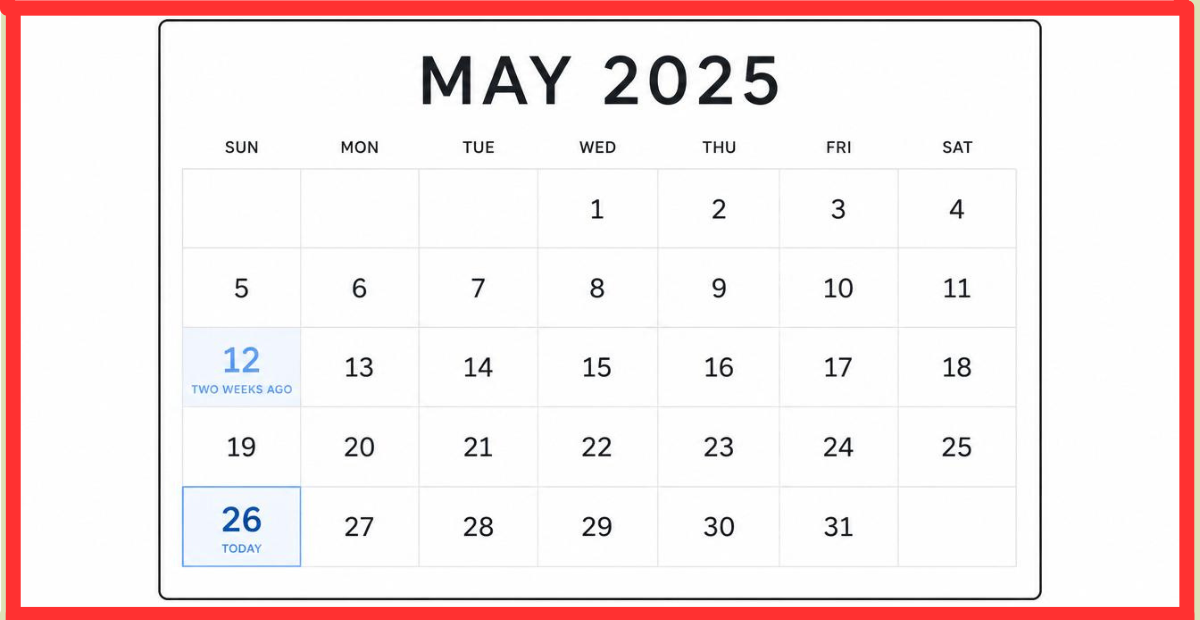
If you’ve ever paused in the middle of your day and thought, “Wait… what date was it exactly two weeks ago?” you’re honestly not alone.
It sounds like one of those tiny questions that should take two seconds, yet somehow it can send you flipping through a calendar, opening your phone, or counting on your fingers like it’s elementary school again. Funny how our brains do that sometimes.
Whether you’re checking an old receipt, verifying a work deadline, remembering an anniversary, reviewing a fitness goal, or simply satisfying your curiosity, knowing what date is 2 weeks ago from today can save you from needless guessing.
Dates quietly shape our lives, and even a small relative date often carries a much bigger story behind it.
Maybe it was the day you started a new habit. Maybe it was when your package shipped. Or perhaps it was just an ordinary Wednesday that later became important. Life has a sneaky way of doing that.
As of the Current date, Today’s date is July 1, 2026. If we perform a simple Past date calculation, the Date 2 weeks ago is Wednesday, June 17, 2026.
Everything else simply grows from that little piece of calendar math, and we’ll explore it in a way that’s practical, easy to follow, and maybe a tiny bit enjoyable too.
What Date Is 2 Weeks Ago From Today?
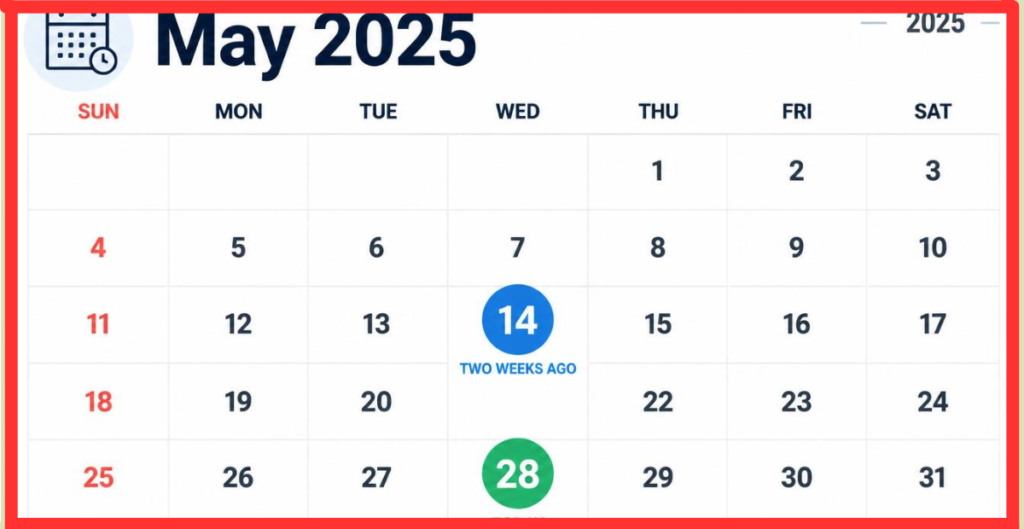
The direct answer is wonderfully simple.
If Today’s date is July 1, 2026, then 2 weeks ago falls on Wednesday, June 17, 2026.
Here’s the calculation in its simplest form:
| Starting Date | Subtract | Result |
|---|---|---|
| July 1, 2026 | 2 weeks (14 days) | Wednesday, June 17, 2026 |
This is an example of Date subtraction, a common form of Date arithmetic used in calendars, planning software, payroll systems, project management, and everyday life.
The answer can also be expressed in several natural ways:
- What date is 2 weeks ago from today? → Wednesday, June 17, 2026
- What was the date 2 weeks ago? → June 17, 2026
- Date exactly 14 days ago → Wednesday, June 17, 2026
- Today minus two weeks → June 17, 2026
- Date two weeks prior → June 17, 2026
They all point to the same Calendar date, even if people ask the question differently.
Understanding the Calculation Behind the Date
You don’t need a fancy Date calculator every time, though it certainly makes life easier.
Here’s how this Date calculation works.
- Begin with the Starting date: July 1, 2026
- Subtract weeks instead of trying to count random dates.
- Since 2 weeks equals 14 days, simply move backward by fourteen calendar days.
- The Resulting date becomes Wednesday, June 17, 2026.
Another way is to Count one week at a time.
First week backward:
- June 24, 2026
Second week backward:
- Wednesday, June 17, 2026
This method reduces mistakes, especially when crossing into another month. It isnt complicated, although people sometimes overthink it.
Breaking Down Two Weeks into Smaller Time Units
Sometimes people need more than just the date. Maybe they’re calculating project durations or programming timers.
Here’s what Two weeks represents.
| Time Unit | Equivalent |
|---|---|
| 2 weeks | 14 days |
| 14 days | 336 hours |
| 336 hours | 20,160 minutes |
| 20,160 minutes | 1,209,600 seconds |
So when someone asks how long 2 weeks really is, the answer depends on which unit feels most useful.
- Days: 14
- Hours: 336
- Minutes: 20,160
- Seconds: 1,209,600
That’s quite a lot of time when you think about it, even though it passes suprisingly fast.
Why People Search for the Date 2 Weeks Ago
The question isn’t random at all.
People search for date 2 weeks ago for many different reasons.
Reviewing financial transactions
Banks often display activity from the previous two weeks, making Past dates especially useful.
Tracking health goals
Someone beginning a workout exactly Two weeks ago may want to compare progress.
Remembering important events
A conversation, meeting, or celebration often happened during a recent Week, making the Previous date important.
Workplace reporting
Many organizations prepare reports covering the last 14 days.
Academic deadlines
Students frequently calculate Date difference when assignments are due or submitted.
Tiny calculations like these quietly appear everywhere, even if we dont really notice them.
Calendar Timeline Around June 17, 2026
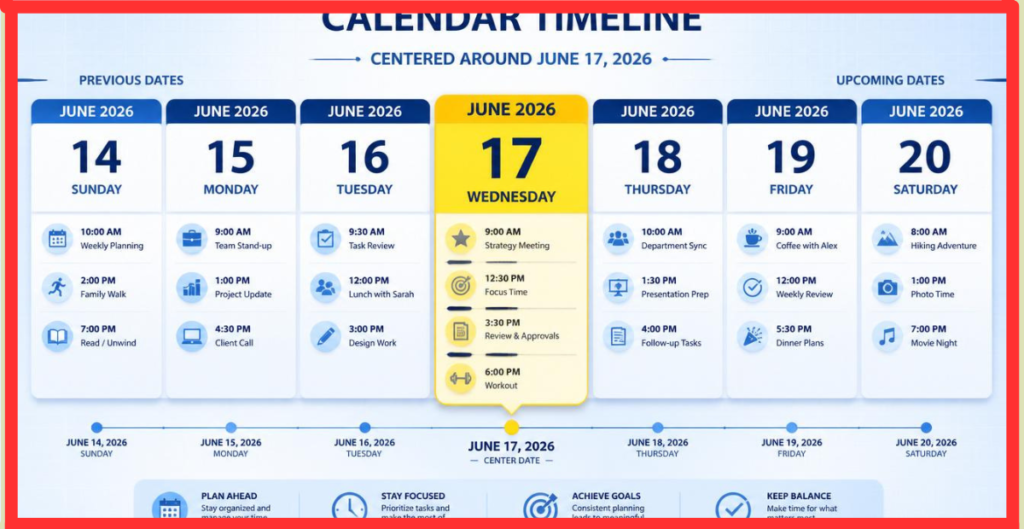
Looking at nearby dates makes the answer easier to visualize.
| Date | Day |
|---|---|
| June 13, 2026 | Saturday |
| June 14, 2026 | Sunday |
| June 15, 2026 | Monday |
| June 16, 2026 | Tuesday |
| Wednesday, June 17, 2026 | Wednesday |
| June 18, 2026 | Thursday |
| June 19, 2026 | Friday |
| June 20, 2026 | Saturday |
| June 21, 2026 | Sunday |
Seeing nearby Calendar weeks often helps avoid accidental counting errors.
The Week Leading Up to Today
Here’s the timeline immediately before July 1, 2026.
| Date | Day |
|---|---|
| June 27, 2026 | Saturday |
| June 28, 2026 | Sunday |
| June 29, 2026 | Monday |
| June 30, 2026 | Tuesday |
| July 1, 2026 | Wednesday |
| July 2, 2026 | Thursday |
| July 3, 2026 | Friday |
| July 4, 2026 | Saturday |
| July 5, 2026 | Sunday |
Viewing the Weekly timeline often makes Calendar counting feel much more intuitive.
How to Count Backwards on a Calendar
If you don’t have a Weeks ago calculator, you can still find the answer manually.
Start with the Original number of weeks you want to subtract.
Then:
- Find the Starting date
- Move backward by each Week
- Continue Counting backward
- Stop after the required number of weeks
Because weeks always contain seven days, the weekday remains the same.
So:
- Wednesday minus one week equals Wednesday.
- Wednesday minus two weeks still equals Wednesday.
That’s why Wednesday, June 17, 2026 lines up perfectly with July 1, 2026.
Understanding Relative Dates
The phrase Relative dates simply means dates measured from another date instead of standing alone.
Examples include:
- yesterday
- tomorrow
- last week
- next month
- 2 weeks ago
- 3 weeks from today
Instead of memorizing fixed calendar dates, you compare them to a Temporal reference, usually today’s date.
This kind of Calendar math appears constantly in software, scheduling apps, booking platforms, and digital assistants.
Date Arithmetic Made Easy

Think of Date arithmetic exactly like regular subtraction.
Example:
July 1, 2026
− 14 days
= June 17, 2026
Or:
July 1, 2026
− 2 weeks
= June 17, 2026
This form of Date offset calculation works because weeks have fixed lengths.
Unlike months, which vary between 28 and 31 days, weeks remain wonderfully predictable.
Using a Date Calculator
Although manual counting works perfectly, many people prefer using a Date calculator.
A modern Weeks ago calculator or Time duration calculator lets you:
- calculate past dates
- calculate future dates
- determine Date difference
- compare two dates
- perform Time calculation
- convert Week intervals
- build a Date table
- generate a Date chart
These tools eliminate human error, especially across leap years and month boundaries.
Related Date Searches
People searching for What date is 2 weeks ago from today often continue with similar questions.
Some common searches include:
- 3 weeks ago
- 4 weeks ago
- 5 weeks ago
- 6 weeks ago
- 3 weeks from today
- 4 weeks from today
- 5 weeks from today
- 6 weeks from today
- 5 years ago
- More dates relative to today
- See all
Each follows the exact same principle of Relative time and Date conversion.
Why the Gregorian Calendar Makes This Easy
Most countries use the Gregorian calendar, which organizes dates into predictable weekly cycles.
Each week contains:
- seven days
- consistent weekday progression
- reliable Calendar counting
Because of this structure, Week-based calculations become surprisingly straightforward.
You don’t have to memorize every month. You only need to understand weekly movement.
Its actually a pretty elegant system when you stop and look at it.
Common Uses for Past Date Calculations
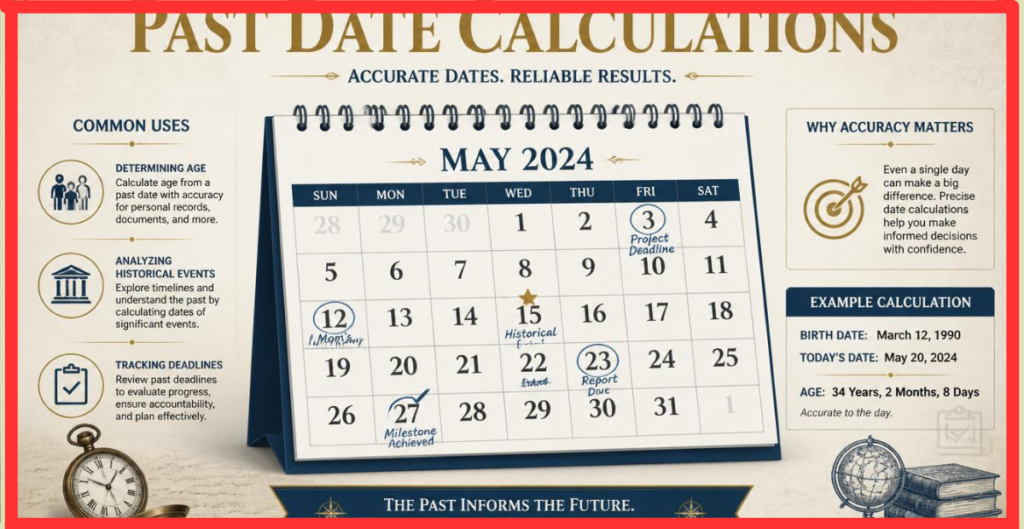
Knowing an exact Historical date has practical value in daily life.
People use Previous dates when:
- checking shipping records
- reviewing invoices
- verifying employment history
- tracking medication schedules
- monitoring habits
- planning vacations
- auditing financial reports
- comparing business metrics
- documenting research
- organizing photographs
Even historians rely on precise Historical dates, although their timelines usually stretch much farther back than just Two weeks.
Frequently Asked Questions
What date was exactly 14 days ago?
If today is July 1, 2026, then 14 days ago was Wednesday, June 17, 2026.
How many days are in two weeks?
Exactly 14 days.
How many hours are in two weeks?
There are 336 hours.
How many minutes are in two weeks?
There are 20,160 minutes.
How many seconds are in two weeks?
There are 1,209,600 seconds.
Why is the weekday the same?
Because Week intervals always contain seven-day cycles, subtracting full weeks preserves the weekday.
Frequently Asked Question
What Day Was It 2 Weeks Ago?
Two weeks ago from today was Wednesday, June 17, 2026. Since two weeks equals 14 days, counting back 14 days from Wednesday, July 1, 2026, gives this date.
2 Weeks Ago From Today
The date 2 weeks ago from today is Wednesday, June 17, 2026. This is exactly 14 days before today’s date.
Two Weeks Ago From Today
If you’re wondering what the date was two weeks ago from today, the answer is Wednesday, June 17, 2026. Simply subtract 14 days from today’s date to find it.
What Day Was 2 Weeks Ago?
Two weeks ago was Wednesday, June 17, 2026. It falls exactly 14 days before Wednesday, July 1, 2026.
2 Weeks Ago Today
2 weeks ago today was Wednesday, June 17, 2026. This calculation is based on today’s date of July 1, 2026 and a difference of 14 days.
Read this blog https://hynoval.com/how-long-until-245-pm/
Final Thoughts
Finding what date is 2 weeks ago from today may sound like a tiny task, but it represents something much bigger: understanding how time quietly moves around us. From tracking projects and remembering milestones to calculating deadlines and reviewing history, even a simple Date lookup connects us to the rhythm of everyday life.
Starting from July 1, 2026, subtracting 2 weeks, or 14 days, leads directly to Wednesday, June 17, 2026. Whether you perform the calculation manually through Backward counting, rely on a Date calculator, or visualize the Weekly calendar, the answer remains consistent.
The next time you need to work with Relative dates, compare Elapsed weeks, perform Calendar calculation, or determine an Exact past date, you’ll know exactly how to approach it. Time keeps moving whether we notice or not, and sometimes glancing two weeks into the past tells a surprisingly interesting little story.