

There are hours in a day that feel ordinary, and then there are hours that start behaving strangely, like they’ve noticed you noticing them. 2:45 PM is one of those moments.
It sits in the mid-afternoon like a quiet checkpoint, not loud like noon, not sleepy like evening, just… waiting.
And somehow, when a mind locks onto it, everything else becomes a kind of background blur, like the world forgot to adjust its brightness properly.
Somewhere in a calendar note written by Jurg Alex (author) dated April 14, 2026, there’s a mention of how people in the Asia/Karachi time zone often experience a “soft drag” in attention when focusing on fixed afternoon times.
That phrase sounds scientific but also kinda emotional, like time itself is slightly tired but still trying.
So the question appears again and again in different forms: how long until 2:45 PM, how much time until it arrives, how many minutes are left, and why does it feel like it changes speed depending on mood.
Even the phrase time remaining until 2:45 PM starts sounding like a heartbeat measurement instead of a clock query.
And yeah, maybe it’s just another point on the AM/PM system, convertible into 14:45 (24-hour format conversion) or even 1445 hours (military time notation), but the human brain rarely treats it that mechanically. It feels personal. Slightly impatient. A bit weirdly emotional, honestly.
| Item | Answer |
|---|---|
| Target Time | 2:45 PM |
| Current Time | Needed to calculate |
| Method | 2:45 PM current time |
| Format | Hours : Minutes : Seconds |
| Result | Varies depending on current time |
| Quick Tool | Use a Countdown Timer or time calculator |
How Long Until 2:45 PM When Time Starts Acting Like It Knows You’re Waiting
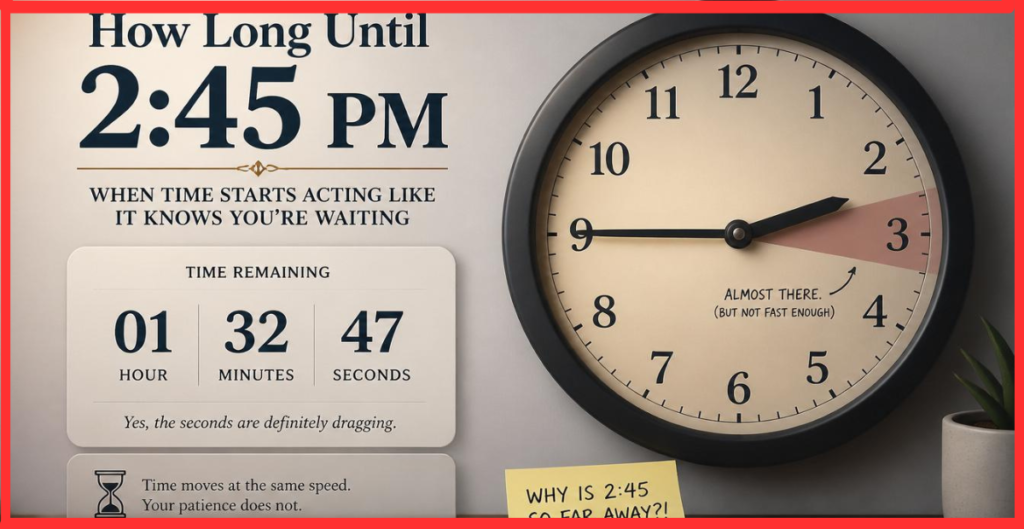
There’s something oddly intimate about staring at the clock before 2:45 PM arrives. Not romantic exactly, but attentive in a way that makes seconds feel louder than they should be.
The real-time countdown state begins in the mind before any actual timer is started, like the brain secretly opened a live countdown timer in the background without asking permission.
People start doing small things checking the clock, re-checking it, forgetting they just checked it. That’s the checking behavior (repeated time checking) loop kicking in, a classic sign of anticipation loop psychology.
It’s not dramatic, but it is persistent, like a thought that refuses to sit quietly in the corner.
In practical sense, tools like a Countdown Timer, Calculators & Reference Tools, or a simple time calculator (online tool concept) can show the exact time difference calculation between now and the target moment.
Websites such as marketbellions.com sometimes explore these digital time behaviors in more abstract ways, linking emotion with computation, which sounds odd but kind of works in practice.
Still, no tool fully captures the feeling of waiting for a fixed afternoon mark. The clock says numbers. The mind says stories.
Here are some expressive “waiting-time wishes” people mentally whisper (or type in notes apps) while watching the minutes crawl:
- May this moment before 2:45 PM pass gently, not like a dragged chair but like soft wind that forgets to rush
- Hope the time calculation tool online feels faster than my thoughts right now, because my thoughts are acting suspiciously slow
- Let the countdown to afternoon time behave kindly, not stretching like chewing gum in heat
- I wish the current time to future time difference would shrink just a little, just enough to notice it smiling back
- May the digital countdown tracker not mock me with slow seconds today, please
- Let my mind stop rechecking the clock like it owes me money
- If time could text back, I’d ask it: “you coming soon or nah?”
And yeah, it’s funny, but the brain really does talk like this when anchored to a moment.
How Long Until 2:45 PM in Real-Time Countdown Systems and Calculators
When people search how long until 2:45 PM, they often expect precision. Numbers. Clean output. A neat breakdown of hours, minutes, seconds. The kind of thing a time difference calculator or scheduling app would give without hesitation.
But behind that simplicity sits a surprisingly layered system.
The AM PM system, 24-hour clock system, and Military time notation are just different languages describing the same slice of reality. When you convert 2:45 PM to 24-hour format, it becomes 14:45, and in military shorthand it turns into 1445 hours.
Same moment, different encoding, like translating emotion into three separate dialects and expecting none of them to feel different.
A live countdown clock doesn’t care about feelings though. It just updates. Tick. Tick. Tick. Almost cold, almost honest.Interestingly, users often refresh these tools more than necessary, feeding into cognitive time tracking behavior.
It becomes less about information and more about reassurance.A small voice inside says: “has it changed yet?” even though time only moves forward, never backward unless your memory is confused.
Some adaptable message-style thoughts people attach to this stage of waiting include:
- If the real-time countdown clock could speak, it would probably sigh at me by now
- The schedule reminder tool is doing its job, I’m just emotionally not cooperating
- I checked the seconds remaining calculator again even though I know it won’t magically shorten anything
- The conversion from 14:45 meaning time format to reality feels longer than expected today
- My focus keeps slipping into the time calculation logic, like I’m trying to hack time itself
- The scheduling mindset I planned this morning is currently offline, please try again later
- Even the calendar anchoring feels like it’s wobbling slightly, not stable at all
There’s also a strange comfort in knowing that every second is measurable, even if it doesn’t feel controllable.
How Long Until 2:45 PM and the Psychology of Waiting
Waiting is not empty time. It’s full, just filled with invisible noise.Psychologists sometimes describe this as subjective time perception,
where the brain stretches or compresses experience depending on attention and emotion. When you focus on how many minutes until 2:45 PM, those minutes don’t behave evenly.
They bend. They hesitate. They sometimes even fake being longer than they are.This is where perceived time slowdown illusion kicks in.
It’s not the clock slowing down it’s the awareness of time becoming sharper, almost uncomfortable in its clarity.
There’s also future-focused attention, where the mind stops fully living in “now” and keeps previewing “later.”
That mental previewing creates a loop: imagine → check clock → imagine again → check again. A soft impatience cycle, not dramatic, but steady.
Even boredom changes everything. The boredom and time perception link is real enough that a single dull moment can feel like it adds extra minutes that don’t technically exist.
People sometimes describe it like this:
- I swear the clock is breathing slower than usual
- My brain is stuck in a weird emotional experience of time, like it’s waiting for permission
- The temporal awareness today feels too sharp, like it’s zoomed in too much
- I keep entering the same anticipation and time awareness loop without meaning to
- The mental time anchoring to 2:45 PM is getting stronger, not weaker
- Even my thoughts are pacing, like they’re waiting in a queue
- The psychology of waiting is doing whatever it wants with my patience today
- I think I just experienced a fake second that didn’t exist
And somewhere in that mental space, the clock is still just doing its normal job, unaffected, unimpressed.
Mid-Afternoon Signals: 14:45, 1445 Hours and Temporal Language Shifts
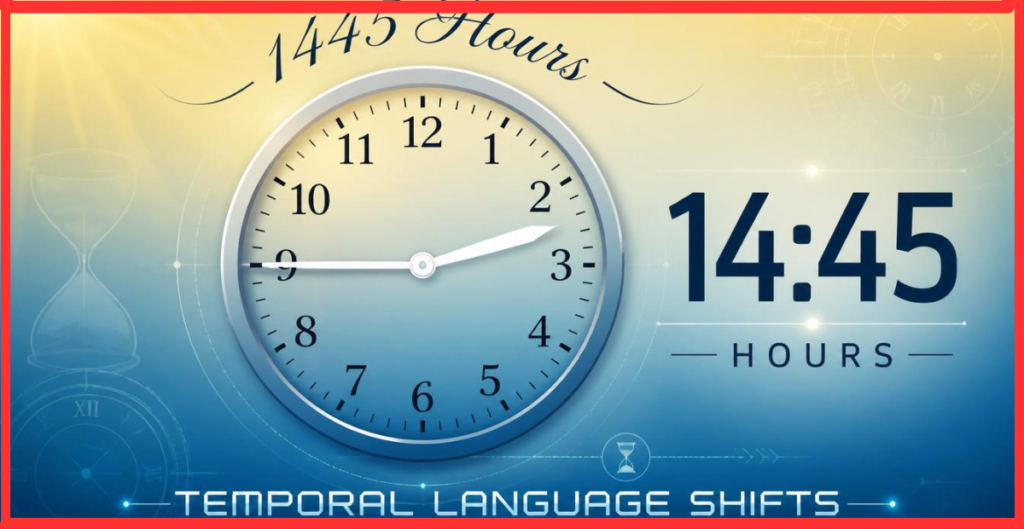
When 2:45 PM arrives or is being approached it exists in multiple identities at once. In casual speech it’s afternoon. In formal scheduling it’s 14:45. In military notation it becomes 1445 hours. Each system carries its own tone, like different accents of the same truth.
The time notation systems we use are not just functional; they shape how we feel about the moment. Saying “2:45 PM” feels soft and human. Saying “1445 hours” feels structured, almost serious, like something is about to happen that requires attention.
This is where temporal language translation becomes interesting. The same moment encoded differently can subtly shift emotional response. Even the brain reacts slightly differently to numeric vs linguistic time framing.
In digital systems, especially those described in conceptual tools like a time calculator (online tool), this moment is just another input-output transaction. But in lived experience, it’s more like a threshold.
Some reflective thoughts that often appear during this mid-afternoon segment:
- The shift from AM/PM system to 24-hour clock system feels like changing glasses mid-day
- I saw 14:45 meaning time format and it felt more “official” than “2:45 PM” somehow
- The phrase 1445 hours (military time notation) sounds like a command, not a moment
- The afternoon time range has this quiet seriousness I didn’t notice before
- My temporal awareness keeps zooming in and out like a faulty camera
- The scheduling computation behind this moment is simple, but my mind is complicating it anyway
- The real-time countdown simulation in my head is more dramatic than reality deserves
- Even the time-based planning I made earlier feels like it belongs to another version of me
And strangely enough, this is where anticipation peaks not at the start, but right before arrival.
Freuently Asked Question
how many seconds until 2:45
You need the current exact time to calculate seconds. The result is the number of seconds between now and 2:45 PM today (or next occurrence if it has passed).
how many hours until 2 45 pm today
The hours depend on your current local time. It is simply the time difference between now and 2:45 PM in hours.
how many more hours until 2:45 pm today
To find this, subtract the current time from 2:45 PM. The remaining result gives the hours left in the day.
how long till 2 45 pm
It is the remaining time from your current moment until 2:45 PM, shown in hours and minutes.
how much longer untill 2:45
The duration depends on the present time. It is the gap between now and 2:45 PM today.
Read this Blog: https://wordzenl.com/how-many-minutes-till-3pm-today/
Conclusion When 2:45 PM Finally Stops Being a Question
At some point, the question how long until 2:45 PM stops being about numbers and becomes about awareness itself.
The clock doesn’t change its behavior, but perception does. That’s the strange trick of time: it stays constant while the mind keeps rewriting its experience of it.
When the moment finally arrives, it rarely announces itself. No applause. No shift in atmosphere. Just a quiet arrival at 14:45 / 1445 hours, as if it had been there all along and we just finally noticed.
The interesting part is not the countdown, but what happens inside the waiting. The small impatience cycles, the repeated checking, the imagined conversations with timers, the emotional weight attached to something purely mechanical. That’s where the real story sits.
If someone wanted to make this experience more personal, a few simple things help:
- Write your own version of a countdown message instead of only checking tools
- Use a Countdown Timer but treat it like a background companion, not a judge
- Try converting times manually using AM/PM system and 24-hour clock system to make it feel more grounded
- Notice when subjective time perception changes instead of fighting it
- And maybe, just maybe, reduce the constant checking it doesn’t actually speed anything up (sadly)
In the end, waiting for 2:45 PM is less about time and more about attention. The clock moves either way. The mind just learns new ways to narrate it.
And if anyone ever asks again how long until 2:45 PM, the honest answer is simple, even if it feels complicated: it’s always closer than it was a moment ago, even when it doesn’t feel like it.