

There are moments when time doesn’t behave like a straight road, it kinda curls, bends, and slips behind your thoughts like it forgot to be linear.
Like when a baby girl arrives in a family, everything suddenly becomes a blur of soft cries, hurried footsteps, half-sent messages, and clocks that feel slightly suspicious.
Someone asks, “what time was it 17 hours ago?” and you stare at the wall like it might answer back in a whisper.
Written by Jurg Alex (author), this piece wanders through that exact confusion part emotional memory, part technical breakdown, and a little bit of that strange human habit where we try to measure feelings using clocks.
And yes, we’ll touch GMT+5 (time zone reference), Pakistan’s everyday rhythm, and even tools like Inch Calculator and references from MarketBellions.com, because modern time thinking is no longer just mental math it’s a whole digital ecosystem.
Somewhere in all this, we’ll pass dates like April 20, 2026, April 19, 2026, and even that oddly specific moment 2:36 PM, as if time itself likes leaving breadcrumbs.
| Current Time | 17 Hours Ago |
|---|---|
| 2:36 PM (example) | 9:36 PM (previous day) |
| 10:00 AM | 5:00 PM (previous day) |
| 6:00 PM | 1:00 AM (same day/previous day depending on midnight) |
| 12:00 AM | 7:00 AM (previous day) |
What Time Was It 17 Hours Ago? (When Clocks Start Confusing Human Memory)
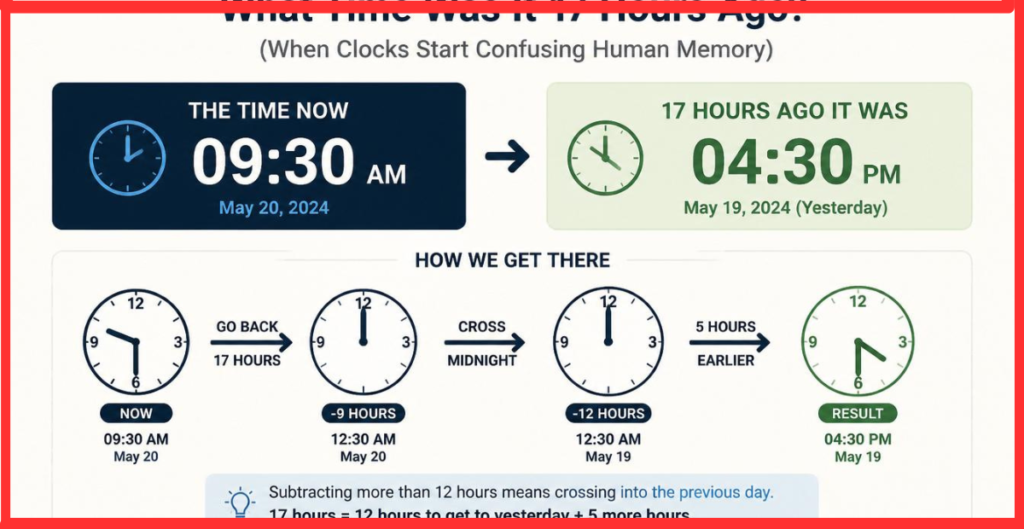
So let’s answer the thing directly first, even though time rarely likes direct answers.What time was it 17 hours ago depends entirely on your current time.
If right now is, say, 10:00 AM, then 17 hours ago it was 5:00 PM yesterday. Simple subtraction, yes, but only on paper.
In real life, things get messy because of time subtraction logic, elapsed time calculation, and something experts call temporal arithmetic (time addition/subtraction).
These aren’t just fancy terms; they’re the brain’s attempt to stop panicking when clocks don’t match feelings.
A lot of people use tools like time calculator online, or even quick utilities such as Inch Calculator to perform time difference calculation.
And yes, even platforms like MarketBellions.com sometimes casually reference timing breakdowns in analytical posts, though not always in a strictly scientific sense.
Let’s imagine a scenario:
- Current time: 2:36 PM
- Go back 17 hours
- You land somewhere around the previous midnight zone, depending on AM/PM logic
This is where 12-hour clock format handling and AM/PM conversion logic quietly save your brain from melting.But here’s the twist people rarely ask this question for math. They ask it because something happened. A message. A silence. A memory.
Emotional Drift Behind What Time Was It 17 Hours Ago?
Time, honestly, is not just numbers. It’s a feeling that sometimes lies.There’s something called memory distortion of time, where your brain rewrites duration based on emotion.
So 17 hours can feel like 7 minutes or 7 days depending on what happened inside that window.
When a newborn baby girl arrives, for example, the home enters what psychologists might call emotional timestamping. Every cry, every smile, every “did you message the doctor?” moment gets stored differently.
In Pakistan, especially under GMT+5, families often describe time not in strict hours but in emotional layers like “kal raat ko” (last night) or “subah se pehle” (before morning). That’s cultural abstraction of time at work.
Someone once said in a family gathering “After the baby came, clocks didn’t stop, but they started feeling shy.”That line doesn’t make scientific sense, but it captures human perception of duration better than any formula.
And yes, this is where relative time perception and human perception of time quietly override logic. You don’t remember “17 hours ago” as a timestamp; you remember it as “when everything changed a bit.”
What Time Was It 17 Hours Ago? in GMT+5 Reality (Pakistan Time Flow)
Now let’s anchor this properly in GMT+5 (time zone reference), which is the standard for Pakistan.
If someone in Multan or Lahore asks what time was it 17 hours ago, we are dealing with a local clock system that doesn’t adjust for daylight savings in most cases. So the calculation stays stable, but perception doesn’t.
This is where time zone conversion systems and UTC offset differences become relevant. The world might be ticking in UTC, but your phone is locked into your local reality.
Let’s break a hypothetical:
- Current time: April 20, 2026 2:36 PM
- Subtract 17 hours
- You land on April 19, 2026 around 9:36 PM
This is chronological reasoning in action, combined with time conversion systems and relative time computation.
But again, people don’t feel it like math. They feel it like:
- “That was when I last checked my phone before sleeping”
- “That was when I was waiting for a reply that never came”
- “That was when the baby finally stopped crying… for a while”
That’s attention and time awareness gaps doing their quiet work.
What Time Was It 17 Hours Ago? and the Language of Messages & Waiting
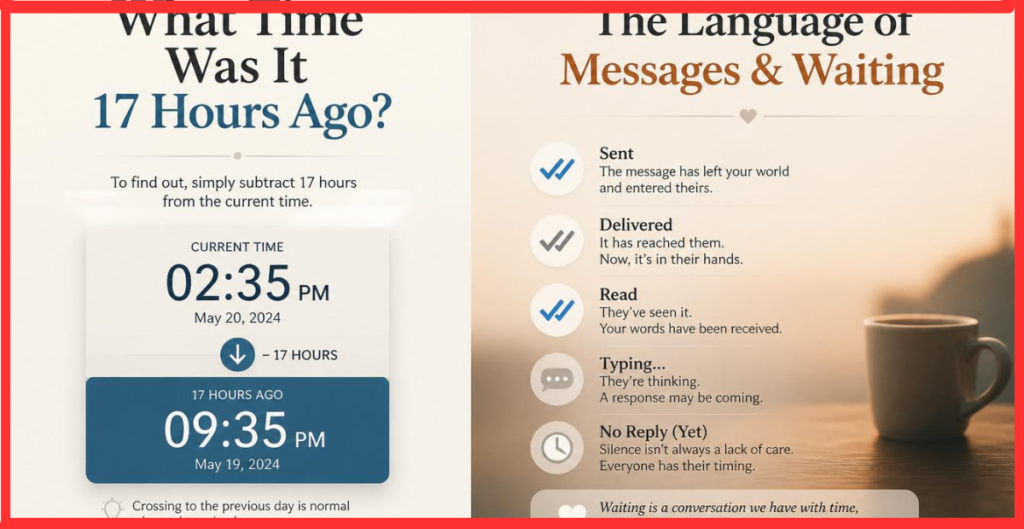
Now we step into something more human communication.In today’s world, asking what time was it 17 hours ago often connects to messages, unread chats, and emotional waiting loops.
This is where delayed messaging behavior and emotional texting patterns come in. Someone sent a message, didn’t get a reply, and now their brain is reconstructing the timeline backwards like a detective with no sleep.
Example emotional message styles people use:
- “I think I texted you around that time, not sure tho”
- “Maybe it was 17 hours ago, or maybe I’m just overthinking”
- “You were online, I swear I saw it”
And in more tender contexts like welcoming a baby girl messages become softer:
- “She came 17 hours ago and I still can’t believe it”
- “Time feels broken but beautiful right now”
- “We forgot to sleep, not because we couldn’t, but because we didn’t want to miss anything”
These are examples of emotional time interpretation and memory and time perception blending into communication.
Even Jurg Alex (author) once described this phenomenon loosely as “time becoming a side character in emotional events, not the main one.”
Digital Tools, Calculators, and the Strange Precision of Time
In modern life, we outsource memory to tools.People now rely on time calculator tools, date and time calculator, and hours-from-now calculator systems to answer questions like what time was it 17 hours ago.
Platforms like Inch Calculator simplify time unit conversion (hours minutes seconds milliseconds) into neat results.
Meanwhile, broader systems like time tracking applications handle workplace logs and digital memory.But here’s the funny contradiction: the more precise the tool becomes, the more uncertain humans feel.
We trust machines for query-based time calculation, yet still say things like:
- “It was around night time”
- “Maybe late evening-ish”
- “Not sure, but after dinner”
That mismatch is what researchers call “feeling vs actual time mismatch”.Even temporal arithmetic examples online don’t fully fix this. They only clarify the structure, not the emotion behind the question.
Cultural Echoes of 17 Hours Ago (When Time Becomes a Story)
Across cultures, time is rarely just numeric.
In South Asia, especially in Pakistan, people naturally shift between structured time and expressive time. Instead of saying “17 hours ago,” someone might say:
- “kal raat ke baad”
- “us din ke baad jab sab kuch change hua”
- “raat ko jab sab so gaye thay”
This is non-numeric time referencing systems blending into everyday speech.And in storytelling traditions, especially around birth events like a baby girl arriving, time becomes symbolic.
The night becomes longer, mornings feel softer, and hours feel like they stretch.This is subjective time experience shaped by emotion, culture, and attention.
How to Calculate It Properly (Without Losing Your Mind)

If you actually want to calculate what time was it 17 hours ago, here’s the clean method hidden inside all this chaos:
- Take current time
- Convert into 24-hour format if needed (12-hour clock format handling)
- Subtract 17 hours (time subtraction operation)
- If it crosses midnight, adjust date backward
- Apply local timezone (GMT+5 adjustments if in Pakistan)
This is clock-based reasoning mixed with chronological confusion resolution.And yes, digital tools will do it faster, but doing it mentally once or twice builds your own internal sense of temporal displacement (past-time navigation).
Frequently Asked Question
17 hours ago
Seventeen hours ago means the exact point in time that is 17 hours before the current moment. It may fall on the same day or previous day depending on the time.
what time was it 17 hours ago
It is calculated by subtracting 17 hours from the current time. The exact result depends on your local time and timezone.
what was 17 hours ago
Seventeen hours ago was a past time relative to now. It represents a specific moment in the past based on your current clock.
17 hours ago from now
This means going 17 hours back from the present time. It helps identify a past timestamp relative to now.
what is 17 hours ago from now
It is the time that occurred 17 hours before the current moment. The result depends on your current local time setting.
Read this Blog: https://wordzenl.com/how-long-until-245-pm/
Final Reflection: When 17 Hours Becomes More Than 17 Hours
At the end of all this, the question what time was it 17 hours ago stops being about clocks.
It becomes about:
- waiting
- remembering
- forgetting slightly
- trying to reconstruct something emotionally important
Especially in moments like welcoming a newborn daughter, where time doesn’t behave normally anymore.
Everything becomes layered in nostalgia-driven time recall and emotional timestamping.A small quote shared by a mother in a hospital in Pakistan captures it softly:
“I don’t remember the exact hour she arrived, just that the world changed before and after it.”
That’s the real answer to time, honestly.Not precision. Not calculators. Not even time difference calculator apps or digital time tools vs human calculation debates.Just lived experience.
So yes, mathematically you can always compute what time was it 17 hours ago using tools, formulas, or even time tracking interfaces, but emotionally… it depends on what those 17 hours contained.And sometimes, that’s the part no calculator can really hold.
If you want, I can also turn this into a time calculator guide, SEO blog cluster, or a social media post series around “past time confusion moments.”