

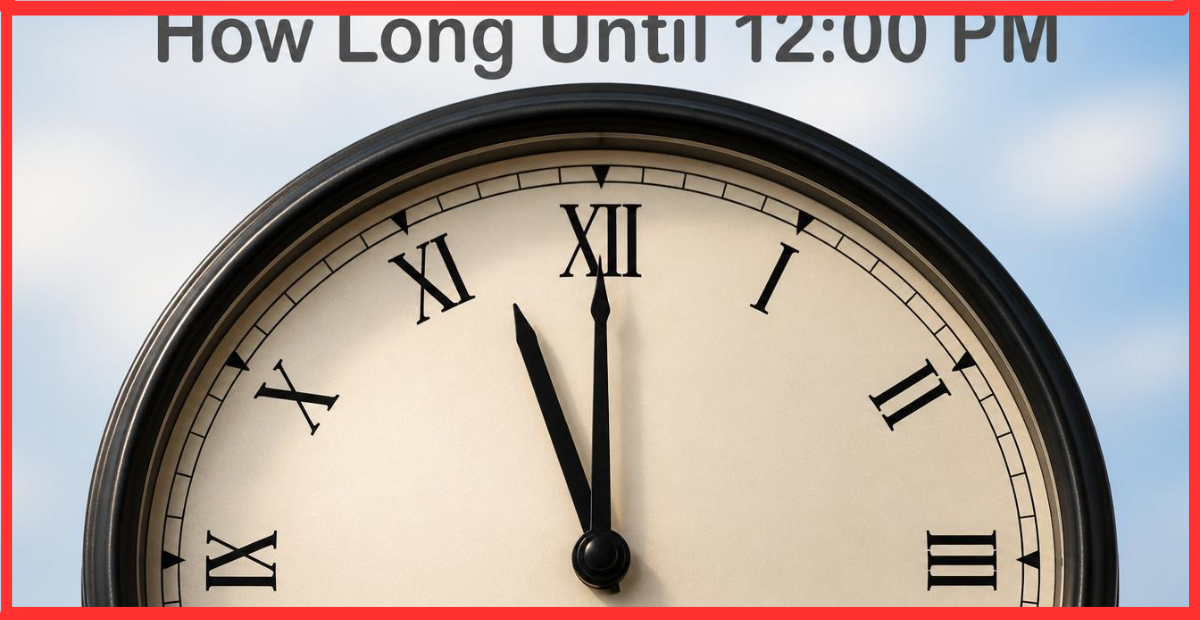
There are mornings that feel like they are stitched together with thin threads of light and impatience, and then there are mornings like this one where everything seems to be quietly asking the same question in different tones: how long until 12:00 PM?
It starts small. A glance at the phone. Then another. Then a slightly unnecessary refresh of the lock screen like the numbers might behave differently if looked at with enough belief.
Right now the current moment snapshot (8:34:01 AM) sits inside the soft hum of the morning, in the Asia/Karachi time zone, where sunlight is already stretching across rooftops and tea kettles are probably already thinking about their second boil.
And somewhere inside this ordinary morning, there is a very precise mathematical reality unfolding:
3 hours, 25 minutes, 59 seconds remain until 12:00 PM / Noon.
Or in another language of machines, 205 minutes, or even more sharply, 12,359 seconds.But honestly… who thinks in seconds unless they are waiting for something?Time here is not just ticking. It is behaving.
It is leaning forward. It is slightly impatient too, like a clock that knows lunch is coming but refuses to say it out loud.We are not just calculating hours today. We are feeling them.
| Current Time | Target (12:00 PM) | Time Left |
|---|---|---|
| 12:00 PM | Please share current |
The Morning Snapshot and the Quiet Math of 8:34:01 AM
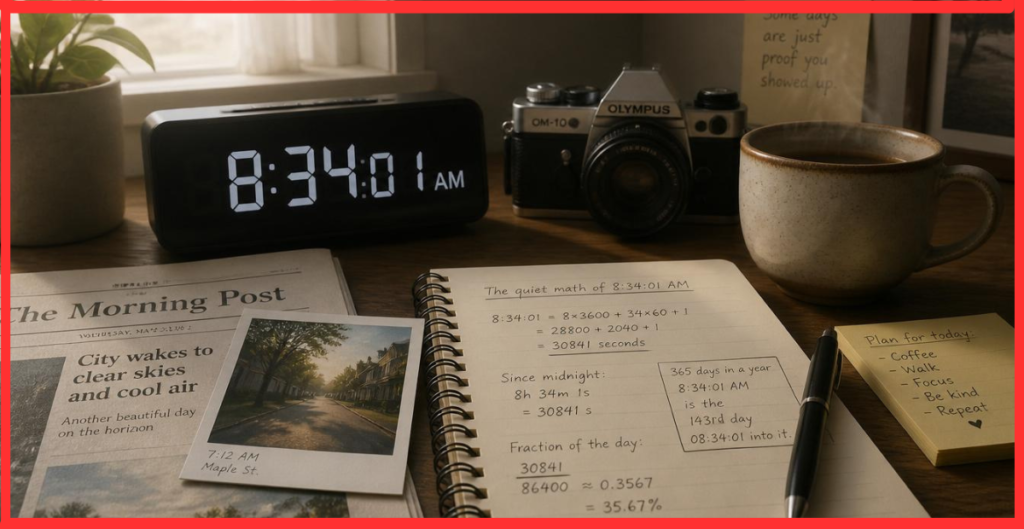
At exactly 8:34:01 AM, the world feels like it is still putting on its shoes. Not fully ready, not fully asleep either. A strange in-between stage where time perception gets soft around the edges.
In the structure of a 12-hour clock system, mornings always carry a kind of polite confusion. AM/PM format tries its best to behave like order, but inside human minds, it becomes more like a suggestion than a rule.
If you switch into a 24-hour time format, the same moment becomes 08:34, which feels more serious somehow, like it belongs in a spreadsheet or a railway announcement.
And if someone whispers 1200 military time, suddenly noon feels like a coded event, like something official is about to happen in the sky.But right now, before that threshold, the day is still in its early negotiation phase.
There is also something quietly mechanical happening beneath this calm: a real-time clock synchronization process that no one sees but everyone depends on.
Phones, wall clocks, microwaves blinking 12:00 for no reason they are all participating in a silent agreement that time should behave consistently.
A schedule tracker somewhere in the background is already preparing the next transition. A countdown timer system is quietly dividing seconds like currency.
A dynamic timer display logic is converting invisible flow into readable numbers And yet, despite all this computation, the human brain still feels like it is just waiting for lunch.Weird, no?
The Mechanics Behind “How Long Until 12:00 PM” (and Why It Feels Longer Than It Is)
On paper, the answer is simple. A temporal calculation tool or time difference calculator would tell you instantly:
- Time remaining until noon: 3 hours, 25 minutes, 59 seconds
- Seconds until 12 o’clock: 12,359 seconds
- Minutes until noon today: 205 minutes
A clean time estimation algorithm running on a server would never hesitate.But humans? Humans hesitate constantly.The temporal difference calculation happening inside the mind is never accurate. It bends.
It stretches. It forgets that day progression (~50%) is still not reached by noon. Morning still owns most of the day, even if it doesn’t feel like it.The truth is, time changes clothes depending on how you look at it.
A time conversion tool can switch between AM/PM and 24-hour formats instantly, but it cannot convert boredom into excitement or impatience into calm. That is outside its permissions.
There is also something funny about how people start checking clocks more frequently when they are waiting. It becomes a loop:
look → wait → forget → look again → slightly surprised time still exists
This is habitual clock checking behavior, and it quietly distorts everything. The more you check, the slower the waiting feels. It’s almost like “time feels slower when watched”, though nobody teaches this in school.
And yet here we are.Still watching.Still waiting for noon arrival event like it’s a guest who is slightly late but very important.
Emotional Perception of Waiting for 12:00 PM (When Time Starts Feeling Personal)
There is a strange emotional layer hidden inside every countdown. This is not just time remaining computation, it is also emotional perception of time passing.
When people wait for countdown to 12 PM, something subtle happens. The mind starts creating fake urgency. Even if nothing important is scheduled, noon begins to feel like a milestone.
This is temporal anticipation, where the future starts influencing the present like it already happened.
In some moments, waiting feels like:
- the clock is moving too slowly
- the room is slightly quieter than usual
- even thoughts are walking instead of running
This is subjective time distortion, where five minutes can feel like twenty, or twenty can disappear like it never existed.
A friend once said (slightly joking, slightly serious):“Noon is never just a time. It is like a small emotional checkpoint where your stomach starts negotiating with your plans.”And maybe that is true.
There is also a philosophical side to it. Some people say “clock as a living entity”, like it watches back when you stare too long. Others think “time as emotional”, not mechanical, but responsive.
In that sense, noon as a threshold event becomes more than just 12:00 PM. It becomes a crossing point between “still waiting” and “finally eating something.”
Cultural Rhythm of Noon in South Asian Daily Life

In many South Asian households, especially in places where lunch is not just a meal but a schedule anchor, noon carries weight.
In the Asia/Karachi time zone, mornings stretch with chores, errands, messages, tea breaks, and slow planning.
Then slowly, almost respectfully, everything starts bending toward lunch.This is not just about hunger. It is about rhythm.
The household begins to shift:
- breakfast leftovers disappear
- sunlight becomes sharper through windows
- people start asking indirect questions like “is it late already?”
This is where morning-to-noon transition becomes emotionally visible.Even without a real-time countdown system, people naturally perform event-based time tracking. Someone looks at the sky. Someone else checks the stove. Someone pretends not to be hungry.
And suddenly, noon is not just a number it is a shared expectation.A grandmother once described it in a simple way:“Morning is like talking.
Noon is like listening. Evening is like remembering.”Not scientifically accurate maybe, but emotionally very correct.
Messages and Wishes While Waiting for Noon (A Strange Collection of Time Thoughts)
These are not typical messages. They are more like small emotional fragments people might think while waiting for how long until 12:00 PM to finally reach zero.
- May this countdown to noon feel shorter than your patience expects, even if your patience is already tired and pretending not to be.
- I hope the remaining time calculator in your mind stops overthinking every passing minute and just lets the clock do its job quietly.
- Wishing your real-time time calculation system (your brain, honestly) stops refreshing every 10 seconds like it’s suspicious of reality.
- May the temporal anticipation you feel slowly soften into calm, even if lunch is still far-ish away.
- If your schedule tracker is confused today, tell it noon is coming anyway, it just doesn’t send notifications.
- I hope your experience of waiting as a cognitive state turns into something light, not heavy like it sometimes does.
- May the time difference calculator in your thoughts stop arguing with itself and accept that 205 minutes is not forever.
- If boredom starts acting like a guest, politely remind it that noon arrival event is already on its way.
- Let your attention drift while waiting not feel like lost time, but like time stretching its legs.
- And if all else fails, just remember: even military time encoding (1200) still arrives at the same lunch table eventually.
Somehow, even these little wishes feel like they are also waiting.
The Strange Beauty of Counting Down to Something So Ordinary
We usually think countdowns are for big things New Year fireworks, flights, deadlines, maybe life-changing moments. But here we are, deeply invested in something as simple as countdown to 12:00 PM.
This is where human experience becomes a bit poetic without trying.
The time as silent engine keeps running beneath everything. The temporal computation engine inside systems does its job perfectly.
But humans add something extra: emotion, hesitation, imagination.We turn seconds until 12 PM into meaning.
Even the time zone localization process happening invisibly in devices is part of this story. Somewhere, a server is aligning clocks so that noon arrives correctly in every region, including Asia/Karachi time zone, without drama.And still, it feels personal.That is the oddest part.
Frequently Asked Question
What does “How Long Until 12:00 PM?” mean?
It shows the remaining time from the current moment until 12:00 PM (midday/noon).
How is the time calculated?
It is calculated by subtracting the current time from 12:00 PM in your local time zone.
Why does the result keep changing?
Because the current time is always moving forward every second, so the countdown updates continuously.
Does it depend on my location?
Yes, it depends on your local time zone. 12:00 PM in one country may be different in another.
Is 12:00 PM the same as noon?Yes, 12:00 PM is commonly known as noon or midday.
Read This Blog https://wordzenl.com/how-many-hours-until-2-45-pm-today/
Conclusion: When Noon Finally Arrives, It Never Shouts
Eventually, all this waiting collapses into a simple moment.The clock flips. 12:00 PM / Noon arrives quietly, without applause. No notification says “you made it.” It just happens.
All the systems real-time clock synchronization, event-based time tracking, time conversion tools, and even human impatience settle down for a moment.
And the funny thing is, once noon arrives, it immediately stops feeling important. The waiting mattered more than the arrival.
If there is one small takeaway here, it is this: time is not just measured, it is experienced unevenly. Sometimes it stretches like rubber, sometimes it disappears like a forgotten thought. The emotional perception of time passing is often louder than the actual clock.
If you ever want to make your own countdown more meaningful, you can try personalizing it:
- attach a small goal to the hour
- write a note for “future you at noon”
- or just notice how many times you check the clock (you might be surprised)
And maybe share your own strange “waiting for noon” moments with others. People usually think they are alone in these little time loops, but they are not.
Because somewhere right now, someone else is also staring at 8:34 AM, doing the same mental math, feeling the same 3 hours and 25 minutes stretch like soft elastic.
And noon, as always, is already on its way.