

There are moments in life when a simple question like what time was it 15 hours ago feels way heavier than it should be.
Maybe someone missed a message, maybe a memory is trying to come back, or maybe it’s just one of those nights when the brain starts doing strange loops of past time, flipping through the day like pages that refuse to sit still properly.
And yeah, funny thing is, you don’t even realise how much subjective perception of time messes with your head until you try to rewind it manually.
Sometimes people ask it casually, like checking tea-break timing or a missed call. But other times it hits emotional layers, like “where was I 15 hours back when everything felt normal?”
That’s where emotional time interpretation kicks in, and suddenly time feels less like numbers and more like memory folding backwards in a slightly confusing way, y’know?
I once heard a parent say (little quote I still remember kinda wrongly but it stuck): “Time don’t move, we just keep forgetting where we left ourselves.” Sounds poetic, slightly off grammatically, but it carries that soft truth about memory-based time recall.
And in all of this, even a small question turns into a whole journey of temporal reasoning, clock arithmetic behavior, and sometimes even overthinking till midnight, when everything feels like it belongs to the previous day but also not quite.
| Current Time | 15 Hours Ago |
|---|---|
| 12:00 AM | 9:00 AM (previous day) |
| 6:00 AM | 3:00 PM (previous day) |
| 9:00 AM | 6:00 PM (previous day) |
| 12:00 PM | 9:00 PM (previous day) |
| 3:00 PM | 12:00 AM (previous day) |
| 6:00 PM | 3:00 AM (previous day) |
| 9:00 PM | 6:00 AM (previous day) |
What Time Was It 15 Hours Ago in GMT+5 (Pakistan Standard Time context)
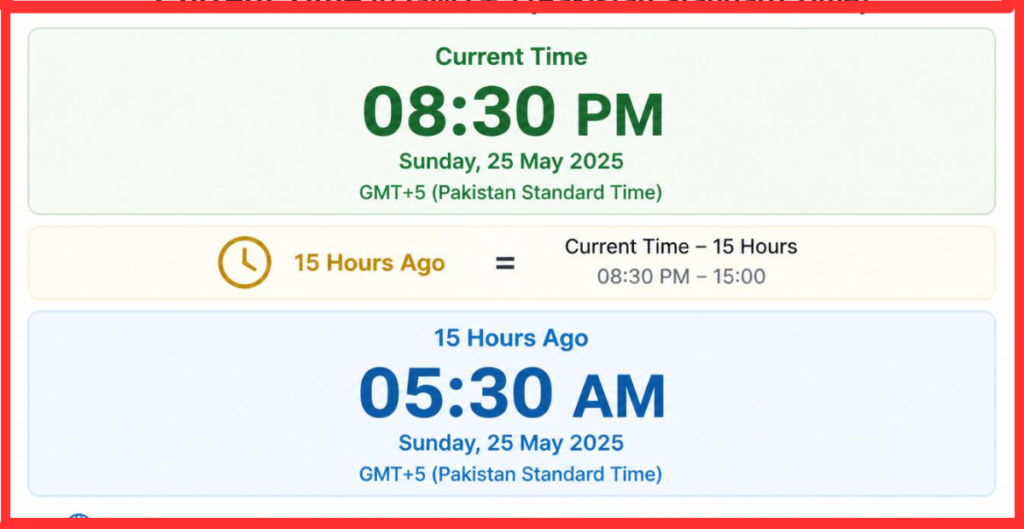
Let’s talk straight first before emotions mess it up. If the current time is say 9:00 PM, then 15 hours ago would take you back to 6:00 AM.
That’s basic subtraction of hours, but when you actually think it through in GMT+5 (Pakistan Standard Time context), things feel a bit more layered than just moving numbers around.
Because time is not just numbers, it’s also time zone calculation, 24-hour format, and that slightly annoying but important AM/PM conversion rules system that makes people pause like “wait is 12 AM midnight or noon again?”
Let’s break how the mind usually handles it (even if a bit messy):
- If current time is 9:00 PM, minus 15 hours ago lands you at 6:00 AM
- If current time is 3:00 PM, 15 hours ago becomes 12:00 AM (midnight)
- If current time is 6:00 AM, 15 hours back might land into the previous day evening around 3:00 PM
This is where clock arithmetic starts acting like a philosophical machine, not just math.
And yeah, people often forget about cross-midnight calculation, so suddenly yesterday and today start blending like tea without sugar properly stirred.
You can always double-check with tools like Inch Calculator, or similar hours-from-now calculator and reverse time calculator, or even a basic time difference calculator tool.
Some folks even use a past time conversion tool, just to avoid mental gymnastics that feel like unnecessary homework.
But still, nothing beats manually doing time interval calculation, even if you mess it up once or twice (or five times, no judgement).
15 Hours Ago Calculation and Clock Arithmetic in Real Life
Now here’s where things get slightly weird but interesting. The idea of 15 hours ago calculation is not just about numbers, it’s about how humans naturally struggle with time subtraction logic when life is already chaotic.
Because when you’re tired, or sleepy, or somewhere between afternoon and evening, your brain stops trusting itself.
So mathematically:
- 15 hours = 900 minutes
- 900 minutes = 54,000 seconds
- 54,000 seconds = 54,000,000 milliseconds
That’s a lot of slicing for something that feels like “just yesterday-ish”.
And this is where time unit conversion and seconds-to-hours conversion become surprisingly useful, especially in digital systems or apps doing date-time computation and time normalization rules across devices.
People don’t realise it, but even small apps rely on temporal subtraction formula hidden behind clean interfaces.
In daily life though, nobody says “I performed a time interval computation today.” They just say “I think it was like 15 hours back or something.”
Funny enough, I once tried explaining this to someone during noon / before noon, and they just said “bro you think too much” and walked off. Fair enough.
But still, this concept shows up in random ways:
- Sleep tracking apps doing time difference calculation
- Travel logs adjusting timezone offsets
- People mentally reconstructing their day using forward time shifting and backward time shifting
- Confused mornings where morning feels like it belongs to another timeline entirely
Time starts behaving like a flexible story instead of fixed reality. A bit like non-linear perception of time, honestly.
Emotional Wishes Around What Time Was It 15 Hours Ago
Now this part might sound unusual, but people often attach emotional meaning to time calculations, even something like what time was it 15 hours ago. It becomes less math, more reflection.
And yes, sometimes even baby-related wishes or blessings get mixed into these thoughts, especially when someone is reflecting on life changes or welcoming a little one into the world.
Here are some warm, slightly quirky, emotionally mixed wishes people might say when reflecting on past time and life moments:
- May the hours that passed 15 hours ago bring soft memories instead of regrets, even if they feel a bit blurry now
- Wishing your past time calculation moments always lead to better mornings and calmer nights
- Hope the time that slipped into the previous day left behind only peace, not confusion
- May your heart understand temporal reasoning confusion a little easier today than yesterday
- Blessings for moments you forgot during afternoon rush and evening chaos
- May every clock arithmetic mistake still guide you to something meaningful somehow
- Hoping your memory of 15 hours ago calculation turns into something gentle, not stressful
- May your emotional sense of lost time awareness slowly settle into calm understanding
- Wishing your life feels less like fragmented daily routine fragmentation and more like flowing rhythm
- May even the weird math of time interval computation feel like part of your story, not burden
In some cultures, people even say time-based blessings during newborn celebrations. A grandmother once said (in slightly broken English but deeply warm): “Baby bring new time, old hours don’t matter anymore.” That kind of line sticks, even if grammar don’t.
How Humans Misread 15 Hours Ago Time (Subjective Perception of Time)
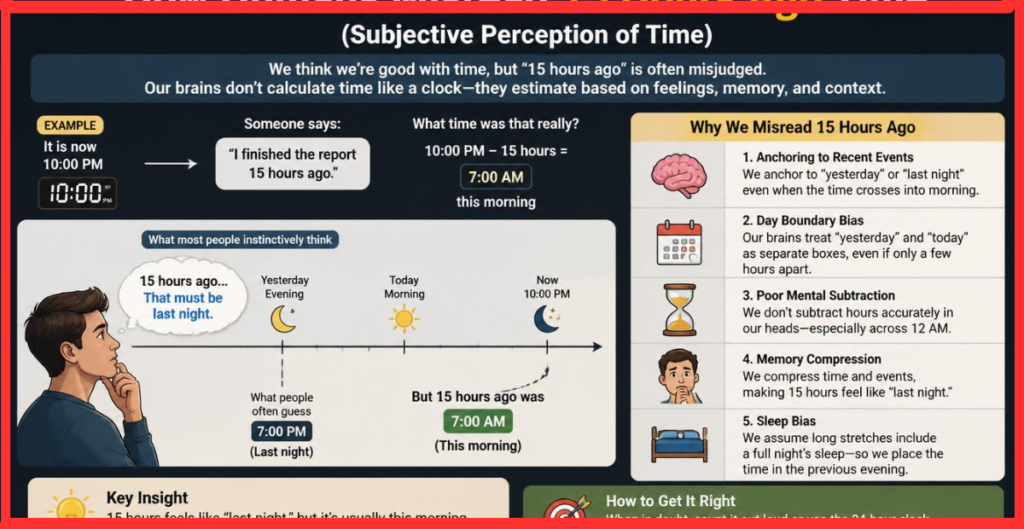
This is where things get honestly funny and a bit chaotic.Humans are not great at temporal reasoning, especially when tired or emotional.
That’s why subjective perception of time can distort everything. Fifteen hours can feel like yesterday, or like a whole different life depending on mood.
Some people confuse 12-hour format (AM/PM system) so badly that they mix up 6:00 PM / 9:00 AM / 12:00 AM / 3:00 PM / 6:00 AM / 9:00 PM like puzzle pieces that don’t belong together.Add stress, and suddenly time bending / fluid time perception becomes real experience.
Common human errors include:
- Thinking 15 hours ago is still “same day” when it crossed midnight
- Forgetting time unit conversion formula basics under pressure
- Mixing up AM/PM conversion rules during late-night scrolling
- Overestimating or underestimating local time difference when talking across regions
- Relying too much on memory instead of actual calculation tools
- Confusing next day with late-night hours of the same cycle
- Thinking “just a few hours back” when mathematically it’s half a day
It’s basically human sense of time passing being unreliable but emotionally convincing.And honestly, it’s okay. Time was never meant to feel perfectly neat anyway.
Tools That Help With 15 Hours Ago Calculation and Time Understanding
When brain stops cooperating, tools step in like quiet assistants.
People often use:
- Inch Calculator
- online hours from now calculator
- time difference calculator
- reverse clock calculator
- past time converter
These help reduce mistakes in calculator-based verification and improve automation of time conversion when mental math fails (which happens more than people admit).
Modern systems also rely on date time computation, minutes to hours conversion, and strict time unit conversion rules so everything stays synced across apps and devices.
Even websites like marketbellions.com sometimes discuss time-related logic in broader informational content, mixing tech explanations with everyday understanding.
Still, there’s something oddly human about not trusting tools sometimes and trying to calculate it yourself three times before accepting the result.That’s just how temporal reasoning confusion works in real life.
Creative Ways People Use 15 Hours Ago in Messages and Wishes
Now let’s make it a bit fun.People sometimes use time phrases like what time was it 15 hours ago creatively in messages, even when not strictly necessary.
Here are some expressive, slightly unusual message styles:
- “If 15 hours ago was a memory, I think I left my peace there too”
- “You know what’s funny? I still feel stuck somewhere around 15 hours back in the day”
- “Hope your yesterday 15 hours ago was kinder than my overthinking night”
- “I don’t even remember what happened 900 minutes ago but I hope it was good”
- “Somewhere in that time interval computation, I think I missed a smile from you”
- “If life had a reverse button like reverse time calculation, I’d maybe press it once… maybe”
- “Between morning and night, I think I lost track of 15 hours and maybe a few thoughts too”
- “My memory and time relationship is kinda messy today, not gonna lie”
- “If time is flowing system, mine just spilled a bit yesterday”
- “Let’s not do time subtraction method on feelings, it never works right anyway”
These kinds of expressions show how even technical time ideas become emotional storytelling devices.
Frequently Asked Question
What Time Was It 15 Hours Ago in GMT+5 (Pakistan Standard Time context)
In GMT+5, you subtract 15 hours from the current local time using clock arithmetic. If the subtraction crosses midnight, it shifts into the previous day automatically.
15 Hours Ago Calculation and Clock Arithmetic in Real Life
This calculation uses time interval computation where you reduce current hours by 15. When the result goes below 0, it wraps around using 24-hour format rules.
Emotional Wishes Around What Time Was It 15 Hours Ago
People sometimes connect past time like 15 hours ago with memories and feelings. It becomes more about reflection than math, linked to emotional time interpretation.
How Humans Misread 15 Hours Ago Time (Subjective Perception of Time)
Humans often get confused with AM/PM and midnight transitions. This leads to errors in temporal reasoning and incorrect mental calculations.
Tools That Help With 15 Hours Ago Calculation and Time Understanding
Online tools like time calculators help verify reverse time calculation quickly. They reduce human error in manual subtraction of hours.
Creative Ways People Use 15 Hours Ago in Messages and Wishes
People use phrases like 15 hours ago to express nostalgia or missed moments. It adds emotional depth to simple time references.
Use 15 Hours Ago in Messages and Wishes
15 hours ago is just a backward shift in time, but it can feel emotional depending on context. It connects math, memory, and human perception of time.
Read tthis blog https://wordzenl.com/how-many-hours-until-2-45-pm-today/
Conclusion: Time, Memory, and the Quiet Meaning of 15 Hours Ago
At the end of it all, asking what time was it 15 hours ago is not just about math or clocks or even GMT+5 (Pakistan Standard Time context) adjustments. It’s also about how humans experience life in uneven waves of memory, emotion, and confusion.
Time is both precise and messy. It follows clock arithmetic, yet it also bends through memory like emotional time interpretation that refuses to stay consistent.
We calculate it with tools, we verify it with systems, but we feel it through stories, missed moments, and strange reflections at night or early morning when everything feels a bit too quiet.
So next time you wonder about 15 hours ago calculation, maybe don’t just solve it. Think about what was happening in that slice of life. Even if it was ordinary, even if it was forgettable, it still existed inside your personal timeline.
And maybe that’s the real answer: time isn’t just what we calculate, it’s what we remember, even when we don’t mean to.
If you’ve ever had a moment where time felt confusing or oddly emotional, you can share it with others too. People usually have more similar experiences than they think, just hidden in different hours of the same day.