

Time is a funny little traveler. One moment it sits quietly beside your morning coffee, and the next it has slipped through your fingers like a fish that never wanted to be caught.
People ask What Time Was It 15 Hours Ago for all sorts of reasons. Maybe you are checking when an email arrived, trying to remember when you last slept, figuring out when a flight departed, or simply untangling a memory that feels half-today and half-yesterday.
What’s strange is that asking about 15 hours ago is not always about numbers. Sometimes it’s about Memory, about Reflections, about trying to place a moment on the map of your day.
The clock gives one answer, but the mind often gives another. A sleepy brain at 2 AM can make three hours feel like thirty, while a joyful afternoon can vanish before you even notice.
In this guide, we’ll explore the mathematics, psychology, and practical applications behind what time was it 15 hours ago, while also looking at why this simple question connects so deeply with everyday human experience.
| Current Time | 15 Hours Ago |
|---|---|
| 6:00 AM | 3:00 PM (Previous Day) |
| 9:00 AM | 6:00 PM (Previous Day) |
| 12:00 PM | 9:00 PM (Previous Day) |
| 3:00 PM | 12:00 AM |
| 6:00 PM | 3:00 AM |
| 9:00 PM | 6:00 AM |
| 12:00 AM | 9:00 AM (Previous Day) |
Formula: Current Time − 15 Hours = Time 15 Hours Ago.
Understanding What Time Was It 15 Hours Ago
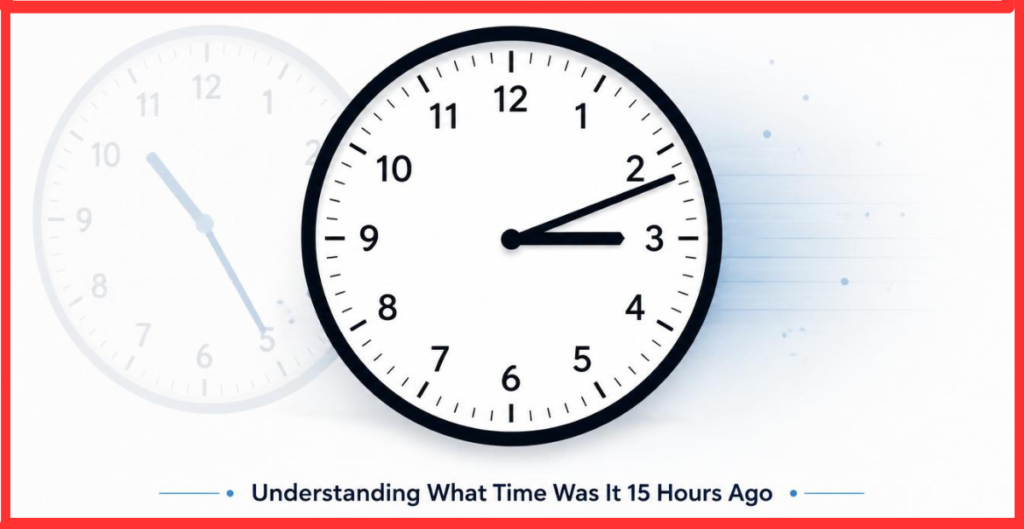
At its core, What Time Was It 15 Hours Ago is a question of Time Calculation. The process is simple: take the Current Time and subtract fifteen hours.
For example:
| Current Time | 15 Hours Ago |
|---|---|
| 10:00 PM | 7:00 AM |
| 6:00 PM | 3:00 AM |
| 3:00 PM | 12:00 AM |
| 9:00 AM | 6:00 PM (Previous Day) |
This type of Time Difference Calculation is used every day, even when people don’t realize it. We do it when checking work schedules, calculating sleep duration, reviewing messages, or tracking travel timelines.
The interesting bit is that fifteen hours often crosses from one day into another. That’s where Date-Time Calculation becomes slightly more complex because you’re not only changing the hour but potentially moving into the Previous Day.
The Mathematics Behind Time Calculation
Every clock follows rules, even if life itself feels wonderfully messy. Calculating 15 hours ago relies on Clock Arithmetic, a method of adding or subtracting hours while keeping track of dates.
Imagine the current time is 8:00 PM.
Subtracting 15 hours gives:
8 PM – 12 hours = 8 AM
8 AM – 3 hours = 5 AM
Therefore, 15 hours earlier was 5:00 AM.
This process is known as Backward Time Shifting. The opposite, adding hours into the future, is called Forward Time Shifting.
In technical systems, this is part of Time Computation, Time Interval Computation, and Chronological Offset calculations. Computers perform these operations constantly whenever apps display timestamps or schedule events.
Oddly enough, your smartphone does thousands of these tiny calculations every day while you just stare at cat videos. Kinda amazing when you think about it.
Clock Arithmetic and Time Shifting Calculation
The phrase Clock Arithmetic sounds like something invented by a professor who drinks tea from a mug shaped like a calculator, but it’s actually pretty practical.
When performing a Time Shifting Calculation, you move backward on the clock by a certain number of hours.
Example:
Current time: 11:00 PM
Subtract 15 hours:
11 PM → 11 AM (12-hour shift)
11 AM → 8 AM (3-hour shift)
Answer: 8:00 AM
This method works regardless of whether you’re using the 12-Hour Format or 24-Hour Format.
For example:
| 24-Hour Format | 15 Hours Earlier |
|---|---|
| 23:00 | 08:00 |
| 18:00 | 03:00 |
| 15:00 | 00:00 |
| 09:00 | 18:00 (Previous Day) |
These calculations form the foundation of Relative Time Expression systems used across digital platforms.
What Time Was It 15 Hours Ago in Pakistan?
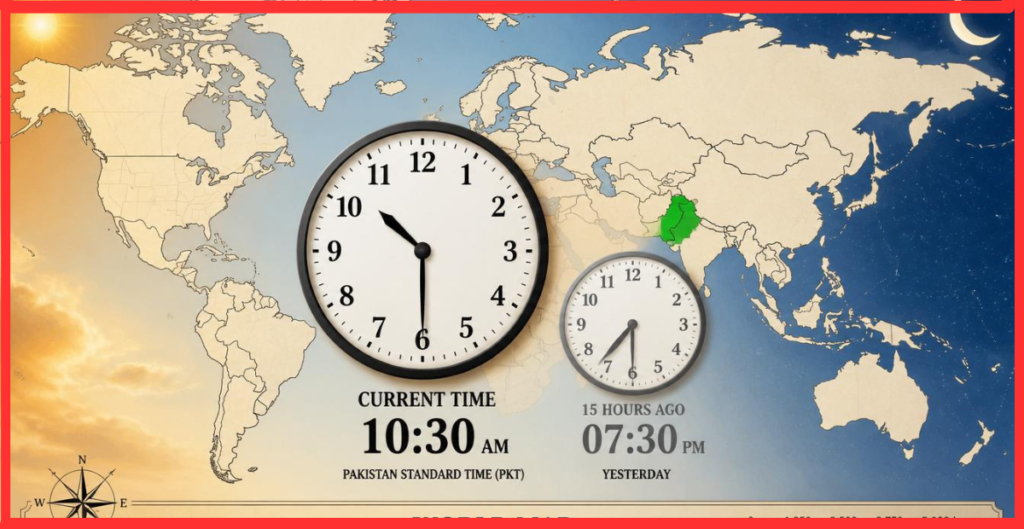
People often search what time was it 15 hours ago in Pakistan because they need a local reference.
Pakistan operates on GMT+5, commonly known as the Pakistan Time Zone.Suppose the Local Time in Pakistan is 9:00 PM.Subtracting fifteen hours gives:
9:00 PM → 6:00 AM
So, the answer is 6:00 AM on the same day.
However, if the current time is 10:00 AM in GMT+5, then moving back fifteen hours places you at 7:00 PM on the Previous Evening.
This is where Time Zone Calculation and Local Time Calculation become important, especially when coordinating meetings across countries.
A person in London and a person in Lahore might be discussing the same event but talking about completely different clock readings. Time can be a bit cheeky like that.
Calculating Time Across Midnight
One thing that trips people up is Midnight.
Crossing midnight means you’re stepping into a different Calendar Date, and that’s where mistakes often happen.
Example:
Current time: 2:00 PM
Subtract 15 hours.
2 PM → 11 PM
But that 11 PM occurred on the Previous Day.
This process is often called Midnight Conversion or Temporal Subtraction.
Many people accidentally focus only on the hour and forget the date shift. That’s why software systems include Time Normalization functions to automatically adjust dates when calculations pass midnight.
Without those systems, honestly, modern scheduling apps would probably melt into chaos by lunchtime.
Converting 15 Hours Into Other Time Units
Sometimes it helps to break fifteen hours into smaller units.
| Time Unit | Value |
|---|---|
| Hours | 15 |
| Minutes | 900 |
| Seconds | 54,000 |
| Milliseconds | 54,000,000 |
So when someone says 900 minutes ago, they’re describing the exact same period as 15 hours ago.
Likewise:
- 54000 seconds ago
- 54000000 milliseconds ago
- 15 hours before now
These are simply examples of Time Unit Conversion.
Computers often perform calculations in milliseconds because they’re easier for systems to process accurately.Humans, though? We generally prefer coffee and simple clock faces.
Human Perception of 15 Hours
Here’s where things become fascinating.The actual answer to how long ago was 15 hours ago is obvious. It’s fifteen hours. Yet our minds rarely experience time so neatly.This is part of Human Perception of Time.Imagine two scenarios:
A person spends fifteen hours waiting anxiously for medical results.Another spends fifteen hours celebrating a wedding.The clock measures identical intervals, but emotionally those periods feel wildly different.
Researchers studying Human Psychology often discuss how emotions influence Time Awareness and Perception Shift.Stress stretches time.
Joy compresses it.Boredom practically puts it on a medieval torture rack.That’s why fifteen hours can feel either like a blink or a century.
Why 15 Hours Ago Feels Like Yesterday
Many people wonder: why does fifteen hours sometimes feel much farther away than it actually is?The answer lies in Time Interpretation and Sleep Cycles.When you sleep between two events, the brain often creates a psychological separation.
For example:
- Something happened at 8 PM.
- You sleep.
- You wake up at 11 AM.
Only fifteen hours have passed.Yet mentally, it may feel like “yesterday” because your brain uses sleep as a natural dividing line between experiences.
This effect influences Memory, Human Thoughts, and overall Human Experience.In a weird way, sleep acts like a tiny editor that reorganizes the story of your life every night.
Time Tracking in Everyday Life
Whether we realize it or not, we constantly perform informal Time Tracking.
Examples include:
- Remembering when medication was taken.
- Checking work hours.
- Monitoring fitness activities.
- Tracking deliveries.
- Reviewing security footage.
- Planning meetings.
Whenever someone asks calculate 15 hours ago, they’re engaging in practical Time Management.
The calculation may seem simple, but accurate timing affects productivity, health, communication, and decision-making.
Even daily Tea Rituals often follow predictable schedules. Miss one and suddenly the whole day feels slightly crooked, somehow.
Common Examples of Previous Day Calculation
Let’s look at some quick examples of Previous Day Calculation.
| Current Time | Time 15 Hours Ago |
|---|---|
| 1:00 PM | 10:00 PM Previous Day |
| 7:00 AM | 4:00 PM Previous Day |
| 5:00 PM | 2:00 AM Same Day |
| 11:00 PM | 8:00 AM Same Day |
These examples demonstrate Date Time Arithmetic and help clarify time subtraction methods.
Whenever calculations cross midnight, the date must also be adjusted.Simple enough on paper, but surprisingly easy to mess up when you’re tired.
Temporal Reasoning and Storytelling
Humans naturally organize experiences through Storytelling.
Think about how people describe events:
“I had dinner fifteen hours ago.”
“The storm started fifteen hours ago.”
“I sent that message fifteen hours ago.”
Each statement relies on Temporal Reasoning.Our brains constantly calculate relationships between Past Events and the Present Moment.
This ability helps us build coherent memories and understand sequences of events.Without temporal reasoning, life would feel like a shuffled deck of photographs scattered across the floor.
Tools for Calculating 15 Hours Ago
Today, many people use:
- Hours ago calculator
- Past time calculator
- Reverse time calculator
- Time difference calculator
- Time elapsed calculator
- Date and time calculator
These tools automate Chronological Calculation, Clock Calculation, and Time Offset Calculation.Instead of manually counting backward, users simply enter the current time and receive an instant result.They’re especially useful when dealing with multiple Time Zones, business operations, or international communication.
How to Calculate 15 Hours Ago Manually
If you don’t have a calculator available, here’s a simple method.
First, subtract 12 hours.
Then subtract the remaining 3 hours.
Example:
Current time: 6 PM
6 PM – 12 hours = 6 AM
6 AM – 3 hours = 3 AM
Answer: 3 AM
This approach simplifies understanding clock arithmetic and reduces mistakes.
It’s a small trick, but a handy one. Kinda feels like teaching your brain a shortcut through a familiar neighborhood.
What Was the Exact Time 15 Hours Ago?
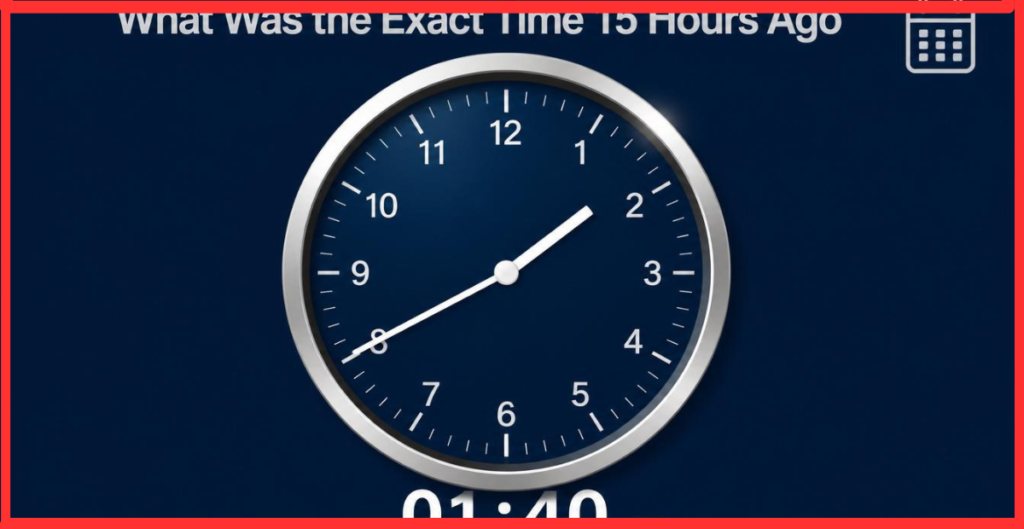
The phrase what was the exact time 15 hours ago depends entirely on the moment you’re asking.
For example:
If it’s currently 4:37 PM, then fifteen hours earlier was 1:37 AM.
Notice that only the hour changes. The minutes, seconds, and even milliseconds remain identical unless additional calculations are involved.
This precision matters in:
- Financial records
- Computer systems
- Event logs
- Medical documentation
- Aviation schedules
Tiny differences in Clock Time can sometimes carry surprisingly large consequences.
Frequently Asked Question
15 hours ago was what time
To find 15 hours ago, simply subtract 15 hours from the current time. For example, if it’s 3:00 PM now, then 15 hours ago was 12:00 AM.
Read this blog https://wordzenl.com/17-hours-ago/
Conclusion
Asking What Time Was It 15 Hours Ago may seem like a straightforward question, yet it opens the door to a much larger world of Time Calculation, Temporal Reasoning, Human Perception of Time, and everyday decision-making.
Whether you’re performing a simple time math exercise, using a reverse clock calculation, checking a previous day time, or exploring timezone based time calculation in GMT+5,
the process follows the same fundamental principles. Subtract fifteen hours, account for date changes, and pay attention to local conditions.
But beyond the numbers lies something more human. Time is not merely a collection of Minutes, Seconds, and Milliseconds.
It’s the structure around our memories, our routines, our conversations, and our stories. Fifteen hours ago might have been a morning coffee, a late-night phone call, a quiet walk, or a moment you’ll remember for years.
So the next time you wonder when was 15 hours ago from now, don’t just look at the clock. Think about what was happening then. Sometimes the calculation is easy, but the memory attached to it is where the real story begins.