

Time is a funny little traveler. It walks beside us all day, sits quietly in the corner during dinner, and then somehow races ahead when we’re not looking.
You glance at the Clock, check the Current Time, and suddenly a question appears that seems simple but carries more weight than expected: what time was it 15 hours ago?
At first, it feels like basic math. Just subtract fifteen hours and move on. Yet the moment you begin thinking about 15 hours ago, your mind starts wandering.
Maybe you remember where you were. Maybe you were sleeping. Maybe you were sharing tea with family in one of those bustling South Asian Households where conversations stretch longer than clocks seem willing to admit.
The idea of looking backward in time, even by a small amount, touches something deeply human. We don’t just calculate hours. We revisit moments.
We connect events. We practice Reflection, revisit Memory, and engage in a surprisingly complex process known as Temporal Reasoning.
In this guide, we’ll explore the answer to what was 15 hours ago, how to calculate it accurately, why time calculations matter, and what those missing fifteen hours can reveal about our daily lives.
| Current Time | 15 Hours Ago |
|---|---|
| 6:00 AM | 3:00 PM (Previous Day) |
| 9:00 AM | 6:00 PM (Previous Day) |
| 12:00 PM | 9:00 PM (Previous Day) |
| 3:00 PM | 12:00 AM |
| 6:00 PM | 3:00 AM |
| 9:00 PM | 6:00 AM |
| 12:00 AM | 9:00 AM (Previous Day) |
Formula:
Time 15 Hours Ago = Current Time − 15 Hours.
Understanding What Time Was It 15 Hours Ago
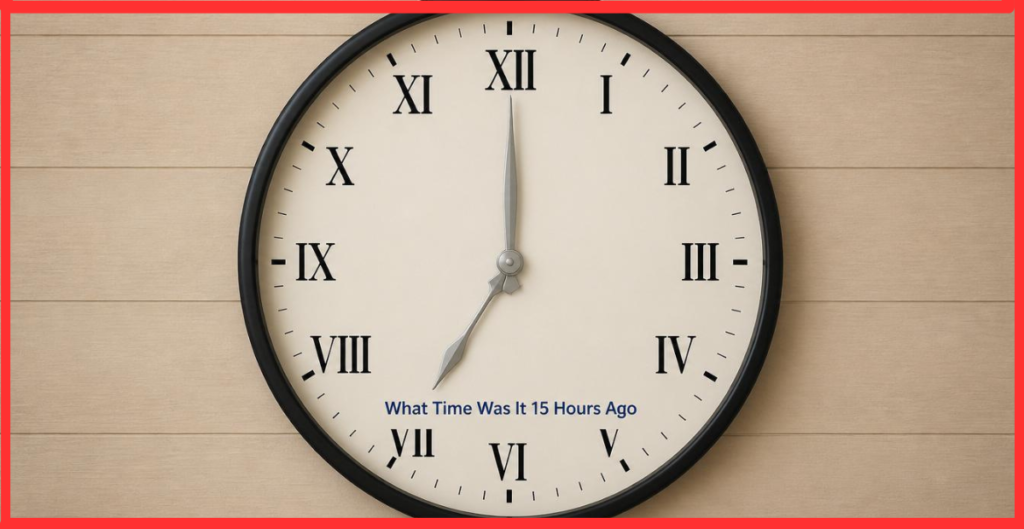
When people search for what time was it 15 hours ago, they’re usually looking for a quick answer. The process itself is a form of Time Calculation.To find 15 hours before now, you simply subtract fifteen hours from the present moment.
For example:
- If the current time is 9:00 PM, then 15 hours ago was 6:00 AM.
- If the current time is 3:00 PM, then 15 hours ago was 12:00 AM or Midnight.
- If the current time is 7:00 AM, then 15 hours ago was 4:00 PM on the Previous Day.
This process is often called Clock Arithmetic because you’re moving backward around the clock rather than forward.
The interesting bit is that a subtraction of fifteen hours often crosses into a different day, making Date-Time Calculation slightly more complex than simple hour subtraction.
Why People Search for What Time Was It 15 Hours Ago
The question isn’t always mathematical.
Sometimes people wonder:
- When did I send that message?
- When exactly did my flight depart?
- What was I doing 15 hours ago from current time?
- Did I sleep enough during that period?
- Was that event yesterday or today?
These questions involve a Time Reference Point, which acts as the anchor for calculating past events.
Human beings naturally organize memories around time markers. We often remember moments not by dates but by situations.
A grandmother might say, “That happened before the evening tea.”A student might think, “That was after lunch but before sunset.
“A parent may remember, “The baby woke up sometime before dawn.”These are all examples of Relative Time Expression, the way humans naturally describe time.
What Time Was It Exactly 15 Hours Ago?
To answer what time was it exactly 15 hours ago, you need the current local time.
Let’s imagine a few scenarios:
| Current Time | 15 Hours Ago |
|---|---|
| 10:00 PM | 7:00 AM |
| 8:00 PM | 5:00 AM |
| 6:00 PM | 3:00 AM |
| 2:00 PM | 11:00 PM Previous Day |
| 9:00 AM | 6:00 PM Previous Day |
Notice how many calculations move into the Previous Day Time.
This crossing of day boundaries is known as midnight crossing and is one of the most common sources of confusion during time difference calculation.
The Mathematics Behind Time Computation
The science behind Time Computation is surprisingly elegant.
A day contains:
- 24 hours
- 1,440 minutes
- 86,400 seconds
- 86,400,000 milliseconds
Therefore, fifteen hours equals:
- 900 minutes
- 54,000 seconds
- 54,000,000 milliseconds
When you calculate 15 hours ago, you’re subtracting:
- 15 hours
- 900 minutes
- 54,000 seconds
from the current moment.
This is often referred to as temporal subtraction, date-time arithmetic, or chronological calculation.Sounds fancy, though honestly it’s just clock math wearing a tidy suit.
What Time Was It 15 Hours Ago in Pakistan?
For users searching 15 hours ago in Pakistan, the answer depends on the Pakistan Time Zone, commonly represented as GMT+5.Suppose the current local time in GMT+5 is 8:00 PM.
Then:
- Current Time: 8:00 PM
- Time 15 Hours Ago: 5:00 AM
This type of calculation requires no Time Zone Adjustment if both times remain within the same zone.
However, if you’re comparing countries, then timezone calculation becomes important.A person in Pakistan and another in Europe may calculate the same event differently due to World Time differences.
Understanding GMT+5 conversion helps avoid confusion when scheduling meetings, flights, or online events.
The Hidden Complexity of Time Zones
People often assume time works the same everywhere.It doesn’t.A meeting held at 8:00 PM in GMT+5 might occur during the afternoon elsewhere.
This introduces concepts such as:
- Local Time Conversion
- Time Zone Adjustment
- Timezone Logic
- Time Shift
- Time Offset
Modern software uses sophisticated Date-Time Calculation Engines to handle these conversions automatically.
Without them, international scheduling would be a beautiful little disaster.
Human Perception of 15 Hours
Here’s where things become oddly fascinating.The clock says fifteen hours.Your brain may disagree.
The field of Human Psychology studies Human Perception of Time, and researchers have found that emotional experiences distort our sense of duration.
A boring meeting can feel longer than a flight.A joyful gathering can disappear in what feels like minutes.
The actual Time Duration remains unchanged, yet perception bends and stretches around emotion.
That’s why how long ago was 15 hours ago sometimes feels like an impossible question.Numerically, it’s easy.Emotionally, it depends.
Morning, Afternoon, Evening, and Night
A subtraction of fifteen hours frequently moves us between different parts of the day.
You may travel from:
- Morning to Evening
- Afternoon to Night
- Night to Morning
- Evening to Midnight
These transitions matter because human activities are strongly tied to time periods.
A memory from 6:00 AM carries a different emotional texture than one from 9:00 PM.The same clock calculation can transport us into an entirely different mood and setting.
Memory and Time: Why We Look Back
Whenever we ask what was the time 15 hours before now, we’re often trying to reconstruct a story.
Maybe:
- We are tracking a delivery.
- We are reviewing work hours.
- We are checking a sleep schedule.
- We are remembering a conversation.
The relationship between Memory Recall and time is incredibly strong.Memory behaves less like a filing cabinet and more like a slightly distracted storyteller.It remembers emotions first.
Details come later.That tiny oddness explains why many people use a past time calculator or reverse time calculator to rebuild timelines accurately.
Sleep Cycles and 15 Hours Ago
Consider a person checking the clock at 9:00 PM.Fifteen hours earlier was 6:00 AM.That period often overlaps with a typical Sleep Cycle.
Sleep researchers frequently examine:
- Wake-up times
- Bedtimes
- Sleep duration
- Daily routines
A time duration calculator can help identify patterns in rest and recovery.
Many people don’t realize how much their energy depends on understanding these intervals.One missed night can make time itself feel wobbly.
Time Storytelling in Everyday Life

Every family has stories attached to hours.
In many South Asian Households, mornings begin with preparation, movement, and sometimes shared breakfasts.Evenings often revolve around conversation.
Then there are Tea Rituals.A cup of tea has witnessed more family history than most calendars ever will.Someone might say:
“Fifteen hours ago we were all sitting together.”
Notice that nobody calculates first.They remember first.Then the clock joins the conversation afterward.
Philosophical Thoughts About Time
The Philosophy of Time asks questions that calculators cannot answer.
What exactly is the past?Does it still exist somewhere?Why does yesterday feel close on some days and impossibly distant on others?
These questions have fascinated thinkers for centuries.The passage of time is both measurable and mysterious.
A clock can tell you what date was 15 hours ago, but it cannot explain why one memory remains vivid while another fades.That gap between mathematics and meaning is where much of human experience lives.
Tools That Help Calculate 15 Hours Ago
Several digital tools can perform reverse time calculation instantly.
Common examples include:
- Time Difference Calculator
- Hours From Now Calculator
- Reverse Time Calculator
- Past Time Conversion Tool
- Inch Calculator (often found on websites offering multiple calculation utilities)
- Similar Time Calculators
These tools automate:
- Time Arithmetic
- Time Conversion
- Time Measurement
- Timestamp Conversion
- Clock Conversion
They reduce mistakes when dealing with large Time Intervals or multiple time zones.
What Day Was 15 Hours Ago?
This depends entirely on the current time.If the current time is early morning, then fifteen hours ago likely occurred during the previous evening.If the current time is afternoon, fifteen hours ago probably falls during the night or early morning of the same date.
For example:
- If today is Sunday at 8:00 AM, fifteen hours ago was 5:00 PM on Saturday.
- If today is 3:00 PM, fifteen hours ago was midnight of the same day.
This is why previous day calculation often accompanies time and date subtraction.
Example Date Calculations
Consider these sample dates:
- April 22, 2026, 9:00 AM
- Subtract fifteen hours
- Result: April 21, 2026, 6:00 PM
Another example:
- April 19, 2026, 2:00 PM
- Minus fifteen hours
- Result: April 18, 2026, 11:00 PM
These examples illustrate how chronological offset affects both time and date simultaneously.
FAQs About What Time Was It 15 Hours Ago
What is 15 hours ago?
It is the exact moment that occurred fifteen hours before the current time, found through Time Calculation.
How do I calculate 15 hours ago?
Subtract fifteen hours from the Current Time using Clock Arithmetic or a calculator.
How far back is 15 hours ago?
It equals 900 minutes, 54,000 seconds, or 54 million milliseconds in the past.
What day was 15 hours ago?
Depending on the current time, it may fall on the same day or the Previous Day.
What time was it yesterday?
That depends on your current time and desired reference point. A reverse clock calculator can determine it accurately.
How many minutes ago was 15 hours?
Exactly 900 minutes ago.
How many seconds ago was 15 hours?
Exactly 54,000 seconds ago.
How many hours ago from now?
If you’re discussing this topic specifically, the answer is fifteen hours before the present moment.
Read this blog: https://wordzenl.com/how-long-until-230-pm/
How to Think About Time More Meaningfully
Beyond calculations, there is value in pausing to consider what those fifteen hours contained.
Maybe they held:
- A conversation you’ll remember.
- A quiet morning.
- A difficult challenge.
- A peaceful walk.
- A family gathering.
Every Time Interval contains stories.The numbers matter, but the experiences matter too.The clock records events. Human beings give them meaning.
Frequently Asked Question
15 hours ago was what time
To find what time it was 15 hours ago, simply subtract 15 hours from the current time. If the subtraction crosses midnight, the result will fall on the previous day.
Rerad this blog https://wordzenl.com/17-hours-ago/
Conclusion
The answer to what time was it 15 hours ago may begin with simple subtraction, yet it quickly opens the door to something larger.
Through Time Computation, Clock Arithmetic, Time Difference, and Date-Time Calculation, we can accurately determine an exact past moment.
Whether you’re using a hours ago calculator, a time subtraction calculator, or doing the math yourself, the process is straightforward.
Still, time is more than numbers. It shapes memories, influences emotions, guides routines, and quietly frames every story we tell.
Fifteen hours can include a sunrise, a night’s sleep, an unforgettable conversation, or a perfectly ordinary moment that somehow becomes important later.
So the next time you wonder when was 15 hours ago from now, don’t just look at the clock. Think about the people, places, and experiences that occupied those hours.
You might discover that the most interesting part of the calculation isn’t the answer itself it’s the memory waiting at the other end of it.