

There are moments in life when time feels like it’s whispering instead of ticking, like it’s leaning in close and asking you to calculate its next move.
Someone might casually ask, “what time is 13 hours from now”, while sipping tea, or staring at a phone screen half asleep, and suddenly it becomes a small mental puzzle that feels bigger than it should. Funny thing is, time does not really rush for anyone, but we keep trying to chase it anyway, don’t we?
Right now, in a quiet reference of 10:09 AM GMT-7 (current time reference), the world already feels like it’s halfway through a breath.
And if we stretch that breath forward by “13 hours from now”, we land gently at 11:09 PM, Friday, July 3, 2026. It sounds simple when written like that, but behind it there’s a whole rhythm of math, logic, and tiny mental adjustments that most people do without even noticing.
Time is weird like that. It behaves like water poured into different shaped glasses, always the same substance but never the same form.
| Step | Time Calculation | Result |
|---|---|---|
| Current Time | Starting point | 10:09 AM GMT-7 |
| Add 12 hours | 10:09 AM + 12h | 10:09 PM |
| Add remaining 1 hour | 10:09 PM + 1h | 11:09 PM |
| Final Answer | 13 hours from now | 11:09 PM, Friday, July 3, 2026 |
What Time Is 13 Hours From Now? Understanding the Core Idea
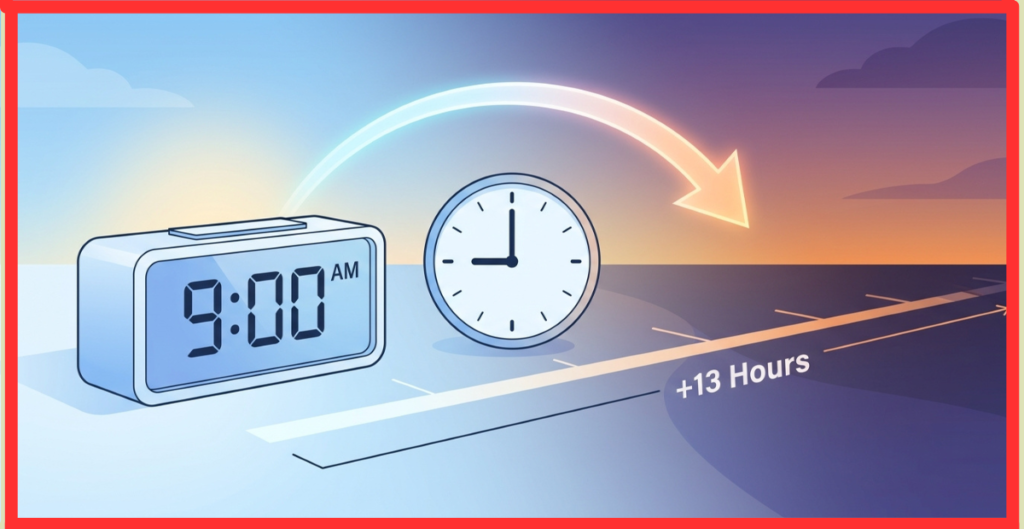
When we talk about “13 hours from now”, we are really talking about a forward jump in the 24-hour cycle of the Earth’s rotation. The idea looks simple on paper, but in real life it involves subtle shifts between AM and PM, and sometimes even a full calendar rollover if the hours push past midnight.
If you take the current time and apply the basic logic of addition of hours to current time, you are basically sliding forward along the clock’s circular path. And yes, sometimes that circle behaves like a loop that surprises people.
To understand it better, let’s break the thought down:
- A day has 24 hours
- Half of it is 12 hours (AM/PM split)
- Adding “thirteen hours” means you cross that halfway point plus one extra hour
- That extra hour is where the confusion usually sneaks in
So when someone uses an hours from now calculator or even a mental time difference calculator online, the system is silently doing conversions like:
- 780 minutes
- 46,800 seconds
- 46,800,000 milliseconds
It’s strange to think that a simple question like what time will it be in 13 hours hides so many layers of numeric transformation underneath.
Breaking Down What Time Is 13 Hours From Now Step-by-Step
Let’s walk through the logic slowly, like we’re drawing invisible circles in the air.Start with the current reference time: 10:09 AM GMT-7 (current time reference).Now apply the core operation: addition of hours to current time.
Step 1: Add 12 hours first (the easy mental chunk)
- 10:09 AM + 12 hours = 10:09 PM
This is where AM PM conversion rules begin to quietly matter.
Step 2: Add the remaining 1 hour
- 10:09 PM + 1 hour = 11:09 PM
And just like that, we reach 11:09 PM, Friday, July 3, 2026, which is the final output of “13 hours from now”.It’s almost poetic how predictable it becomes once you understand the pattern.
But behind this simplicity lies a deeper structure called AM/PM conversion logic, which ensures the clock resets correctly after 12 hours. Without it, we’d all be walking around thinking 25 o’clock is a normal thing, which… honestly, sounds kind of fun but confusing.
If we extend this method into formal thinking, we get something like:
- 24-hour time conversion ensures no ambiguity
- subtract 12 when hours exceed 12 helps convert military time
- time rollover (next day logic) handles midnight crossing
And suddenly, a basic question turns into a small lesson in chronology.
How to Calculate What Time Is 13 Hours From Now Manually
People often rely on digital tools, but understanding how to calculate time manually is oddly satisfying. It gives you a sense of control over something that usually just flows past you.
Here’s a simple mental approach:
- Take the current hour
- Add 13
- If the result is more than 12, adjust using AM/PM conversion
- Check if the date rolls over
This is the basic time calculation method, and even though it sounds structured, real-life thinking is often messier. People forget, recalculate, or suddenly realize they subtracted instead of added. Happens more than we admit.
There’s also something grounding about doing it without tools, even though we have perfect digital helpers like:
- hours from now calculator tool
- future date and time calculator
- time conversion tool
- time difference calculator
Still, humans like mental math because it feels real, even if it’s slightly imperfect.
Tools That Help You Understand 13 Hours From Now Time and Date
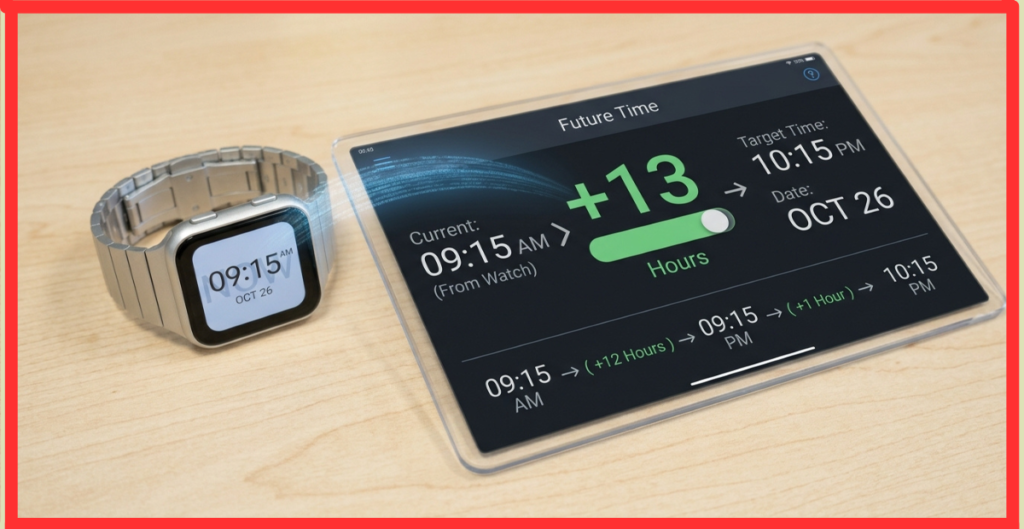
In today’s digital world, nobody really needs to calculate manually anymore. Most people just type their question into an hours from now calculator, and the answer appears instantly like magic.
These tools are built on structured logic:
- They apply AM/PM conversion rules
- They use system time (often synced globally)
- They apply time arithmetic explanation models
- They account for time zone GMT-7 differences
So when you ask “13 hours from now time and date”, the tool silently runs a chain of calculations involving:
- Clock normalization
- Time zone alignment
- Date boundary checks
And suddenly you see a clean answer like 11:09 PM Friday, July 3, 2026 without realizing the computation behind it.
People like Joe Sexton (Byline author) and reviewers like Pateakia Heath, PhD (Reviewer) often emphasize that time tools are not just convenience they are consistency engines that prevent human error in scheduling, travel, and planning systems.
Why “13 Hours From Now” Feels Different Than Other Time Gaps
Interestingly, 13 hours ahead is one of those time jumps that feels slightly off balance. It’s not a clean half-day, and it’s not a full-day cycle either. It sits awkwardly between sleep cycles, work schedules, and night transitions.
Some people even say it feels like:
- A late-night future
- A half-sleep projection
- A “tomorrow-but-not-quite” moment
There’s something emotional hidden in that calculation too. One traveler once said, “When I think 13 hours ahead, I don’t see numbers, I see lights turning off in one place and turning on somewhere else.” It’s not scientific, but it feels true in a strange way.
Understanding the Math Behind 13 Hours From Now
If we get slightly technical, the transformation includes multiple conversion layers:
- 780 minutes total shift
- 46,800 seconds of continuous time flow
- 46,800,000 milliseconds of digital precision
Each layer helps systems like clocks, servers, and apps maintain accuracy across regions.This is why time conversion online systems are so reliable they don’t just think in hours, they think in stacked units of precision.
Even the idea of time calculation steps explained becomes important in programming, aviation schedules, and global communication systems.
Real-Life Situations Where 13 Hours From Now Matters

You might not think about it often, but this calculation quietly shows up in real life:
- Flight departure planning
- Medication schedules
- Online meeting coordination
- International gaming events
- Streaming release timing
People often rely on future time calculation systems without even realizing it. One small mistake in AM/PM conversion can shift entire plans by hours, which is why clarity matters more than speed sometimes.
Common Mistakes When Calculating 13 Hours Ahead
Even simple calculations can go sideways. A few common errors include:
- Mixing up AM and PM transitions
- Forgetting the 24-hour clock structure
- Ignoring midnight rollover
- Adding instead of subtracting in reverse queries
- Misreading digital clock formats
The funny part is, these mistakes usually happen when people are tired or rushing, which is exactly when they are least likely to double-check.
Why We Keep Asking “What Time Is 13 Hours From Now”
At its core, this question isn’t just about numbers. It’s about anticipation. About imagining a version of the world that hasn’t happened yet but is already quietly forming.
When someone asks what time is 13 hours from now, they are often:
- Planning something
- Waiting for something
- Or just mentally projecting ahead
Time becomes less of a measurement and more of a feeling. A soft expectation of what is coming next.
Frequently Asked uestion
⏰ what time will it be in 13 hours
In 13 hours, the time moves forward by 780 minutes, crossing AM/PM boundaries using standard 24-hour conversion logic. It depends on your current time, but the calculation follows simple addition of hours to current time and may include next-day rollover.
⏳ what time was it 13 hours ago
13 hours ago means subtracting 780 minutes from the current time using time calculation method and AM/PM conversion rules. If it crosses midnight, it rolls back to the previous day automatically.
🔮 what is 13 hours from now
“13 hours from now” is a future time and date calculation where you add 13 hours to the current time using addition of hours to current time and 24-hour time conversion rules, including possible time rollover (next day logic).
🕒 whats 13 hours from now
This is the same query as above: you calculate forward by 13 hours using time arithmetic explanation and AM/PM conversion logic. The result depends on current time zone GMT-7 or your local current time.
📍 what time is it in 13 hours
In 13 hours, the clock will shift forward using future time calculation rules. You simply add 13 hours to the current time, apply subtract 12 when hours exceed 12 rule, and adjust AM/PM accordingly.
Read this blog https://hynoval.com/things-that-are-8-inches-longs/
Conclusion: Time Always Moves, Even When We Pause
In the end, “what time is 13 hours from now” is more than a calculation. It is a reminder that time is always in motion, even when we are not.
From 10:09 AM GMT-7 (current time reference) to 11:09 PM, Friday, July 3, 2026, we see how neatly the universe keeps its rhythm, no matter how messy our thoughts get.
Whether you use a time difference calculator, a time conversion tool, or just your own mental math, the answer always leads to the same truth: time moves forward, quietly, without asking for permission.
And maybe that’s the most human part of it we keep trying to measure something that never actually waits for us.
If you’ve ever calculated a future moment and felt something about it, share it. People always have their own strange little ways of experiencing time, and those stories often matter more than the numbers themselves.