

There is something strangely humbling about measuring tiny amounts. A few little digits on a bottle, a spoon, or a syringe can completely change the outcome of what you’re trying to do.
Whether you’re preparing medication for a child, mixing laboratory chemicals, or following a baking recipe that asks for precise measurements, understanding mg to mL Conversion isn’t just another math exercise.
It actually becomes a practical life skill that quietly sneaks into everyday moments.I still remember watching someone confidently pour liquid medicine into a measuring cup because they thought milligrams and milliliters meant the same thing. They don’t, not even close.
The mistake was caught just in time, thankfully, but it was enough to remind everyone in the room that units exist for a reason. Funny how something so small can carry so much weight, if that makes sence.
This guide explores everything you need to know about Milligrams to Milliliters, from the basic science behind the conversion to real-world examples involving medicine, cooking, chemistry, and laboratory work.
Along the way, you’ll discover why density changes everything, how professionals avoid conversion mistakes, and how simple tools like a mg to mL calculator make life considerably easier.
| Milligrams (mg) | Milliliters (mL)* |
|---|---|
| 1 mg | 0.001 mL |
| 5 mg | 0.005 mL |
| 10 mg | 0.01 mL |
| 25 mg | 0.025 mL |
| 50 mg | 0.05 mL |
| 100 mg | 0.1 mL |
| 250 mg | 0.25 mL |
| 500 mg | 0.5 mL |
| 1,000 mg | 1 mL |
What Is the Difference Between Milligrams and Milliliters?
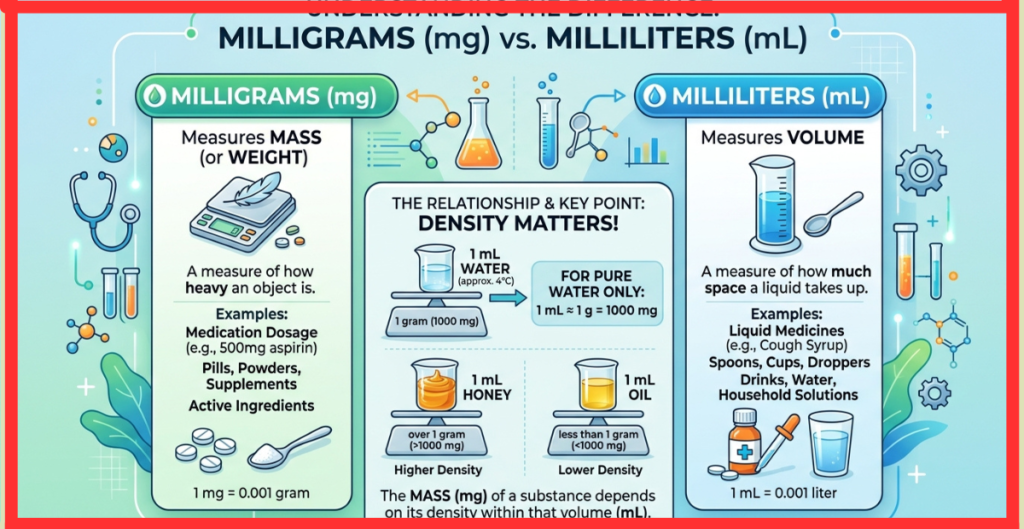
Before attempting to Convert mg to mL, it’s important to understand that these measurements describe completely different physical quantities.
A Milligram (mg) measures Mass, while a Milliliter (mL) measures Volume.That single difference changes everything.
Think of it this way. If someone hands you a feather weighing one gram and a tiny steel ball weighing one gram, they have exactly the same mass.
Yet the feather occupies much more space. Volume and mass are connected through one magical property:
Density
Without density, there simply isn’t a universal way to perform a Milligram to Milliliter Conversion.
Some related measurement units you’ll commonly encounter include:
- Gram (g)
- Kilogram
- Liter (L)
- Cubic centimeter (cc)
- Fluid ounce
- Teaspoon
- Tablespoon
- Cup
- Pint
- Quart
- Gallon
- Pound
- Ounce
- Grains
These belong to different measurement systems, yet professionals regularly convert between them depending on the application. It sounds messy at first, but it kinda becomes second nature after a while.
Understanding the Science Behind mg to mL Conversion
Here’s where things become interesting.
Whenever you convert milligrams into milliliters, you’re performing a mass to volume conversion.Mass alone isn’t enough.
Volume alone isn’t enough.The missing piece is Density.Density tells us how much mass exists within a certain volume.
Mathematically:
Volume = Mass ÷ Density
That simple relationship powers nearly every weight to volume conversion used in medicine, pharmacy, chemistry, food production, and industrial manufacturing.
This is why you’ll often hear people discussing:
- Density calculation
- Conversion factor
- Measurement accuracy
- Material density
- Liquid density
- Chemical density
- Ingredient density
- Weight measurement
- Volume measurement
Without density, trying to calculate milliliters from milligrams is a bit like asking how many pages are in happiness. The question itself misses an important ingredient.
mg to mL Conversion Formula Explained
The standard mg to mL formula is surprisingly simple.
mL = mg ÷ (mg/mL concentration)
Or, when using grams per milliliter:
Volume = Mass ÷ Density
This is known by several names:
- milligrams to milliliters formula
- conversion formula
- conversion equation
- density formula
- volume formula
- measurement conversion
The calculation itself isn’t difficult.Choosing the correct density is where accuracy really matters.
Professionals double-check the density before calculating because even a small mistake can create large errors later on.
Why Density Changes Every Conversion
Imagine placing one liter of feathers beside one liter of iron.Same volume.
Completely different weight.
Now imagine measuring one milliliter of:
- Water
- Honey
- Cooking oil
- Milk
- Liquid medicine
Each has a different density.
That’s why density conversion is the foundation of every reliable Milligram to Milliliter Conversion.
Common examples include:
- density of water
- density of milk
- density of cooking oil
- density of flour
- density of sugar
Even dry powders behave differently because of compaction, trapped air, and clumping. Two scoops that appear identical might contain noticeably different masses. Nature can be sneaky like that.
How to Convert Milligrams to Milliliters Step by Step
Learning how to convert milligrams to milliliters becomes much easier when broken into manageable steps.First, identify the amount in Milligrams (mg).
Second, determine the concentration or density of the material.
Third, divide the mass by the density.Finally, express the answer in Milliliters (mL).
That’s essentially how pharmacists, chemists, laboratory technicians, and food scientists perform pharmaceutical conversion, chemistry measurements, and ingredient conversion every day.
The arithmetic isn’t the hardest part. Finding the correct density usually takes longer than doing the calculation itself, funny enough.
mg to mL Calculator: Why People Prefer Automated Tools
Modern technology has made conversions dramatically easier.
A good mg to mL calculator reduces the chances of arithmetic mistakes while speeding up routine calculations.
Many professionals rely on:
- conversion calculator
- metric calculator
- dosage converter
- liquid calculator
- mass calculator
- volume conversion tools
- weight calculator
- liquid volume calculator
- ingredient volume calculator
- medication dosage calculator
- dosage volume calculator
These calculators are especially valuable when precision matters, such as preparing medications or conducting scientific experiments.
Still, calculators should support understanding, not replace it. Knowing why the numbers work builds confidence that no machine can really hand over.
Real-Life Medication Examples

Healthcare professionals perform Medication mg to mL Conversion constantly.Doctors prescribe medication using Prescribed dosage measured in milligrams.
Patients usually receive liquids measured in milliliters.That means someone must accurately convert between the two.
Examples include:
- Liquid suspension
- Medicine concentration
- Drug dosage
- Suspension dosage
- Liquid medication conversion
- Medicine dosage conversion calculator
- Pharmaceutical measurement conversion
Pharmacists are trained extensively because dosing errors can become serious very quickly.As one experienced pharmacist once explained:
“Always measure twice when medicine is involved. Precision is a form of care.”That’s a lovely way to think about it, honestly.
Cooking and Baking: Another Place Where Conversion Matters
Most people don’t associate mg into mL calculations with baking.Yet food scientists and commercial kitchens perform these conversions every day.Different ingredients have different densities.
Examples include:
- Water mg to mL conversion
- Milk mg to mL conversion
- Oil mg to mL conversion
- Flour mg to mL conversion
- Sugar mg to mL conversion
You’ll often encounter:
- Cooking ingredients
- Baking ingredients
- Dry ingredients
- Wet ingredients
- Measuring ingredients
- Kitchen conversions
- Cooking conversion
- Baking conversion
Professional bakers frequently prefer measuring by weight because it’s generally more accurate than measuring by volume.
Home cooks often discover this after making the same bread recipe twice and wondering why one loaf suddenly became a brick. Been there, almost.
Chemistry and Laboratory Applications
Scientists rely heavily on accurate Scientific Measurement.
Laboratories routinely calculate:
- Laboratory measurements
- Laboratory calculations
- Chemistry mass to volume conversion
- Chemical mixtures
- Chemical mixing
- Mass-volume stoichiometry
- Stoichiometry
- Yield of reaction
- Reaction yield
- Aqueous solution
- Powdered chemicals
- Aqueous chemicals
- Chemicals
Even tiny conversion errors can affect experimental outcomes.
That is why laboratories invest in calibrated equipment and standardized procedures to maintain Measurement accuracy.
Measurement Equipment That Makes Life Easier
Reliable tools improve reliable results.
Common measuring equipment includes:
- Digital scale
- Kitchen scale
- Calculator
- Measuring devices
- Measuring equipment
- Graduated cylinders
- Measuring spoons
- Laboratory pipettes
A digital scale measures Mass measurement, while measuring cylinders determine Volume measurement.
Using the wrong tool almost guarantees inaccurate results.
The Metric System Makes Everything Simpler
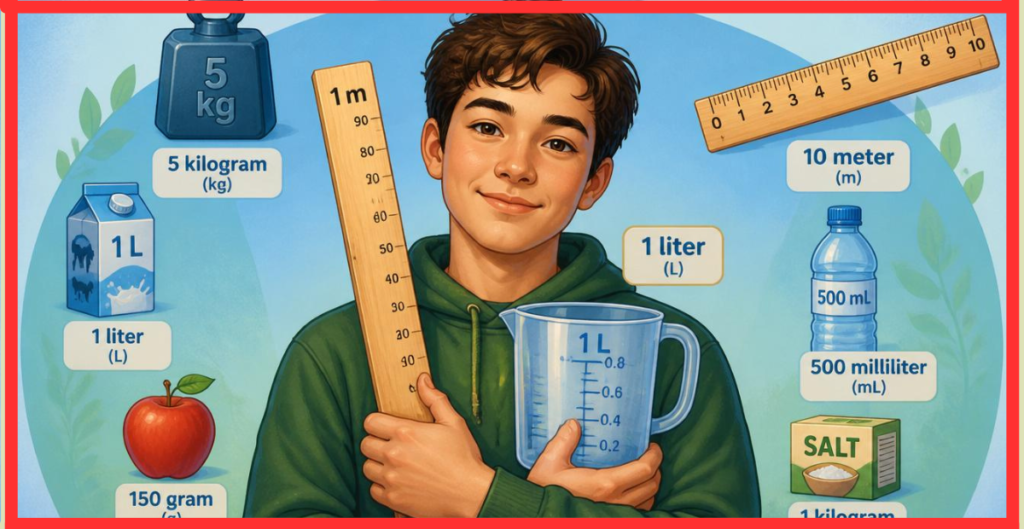
The beauty of the Metric system lies in consistency.
The SI units provide standardized measurements across science, medicine, engineering, and education.
Important metric units include:
- Milligram (mg)
- Gram (g)
- Kilogram
- Milliliter (mL)
- Liter (L)
Understanding the milli prefix helps enormously.Milli means one-thousandth.
So:
- 1 gram = 1000 milligrams
- 1 liter = 1000 milliliters
Simple patterns reduce confusion, even though people still mix them up now and then.
Organizations That Promote Accurate Measurement
Several respected organizations contribute to measurement standards worldwide.
Among them are:
- National Institute of Standards and Technology (NIST)
- National Institute of Standards & Technology
- CK-12 Foundation
- LibreTexts
Educational authors including Joe Sexton and Ethan Dederick have also helped explain unit conversions through accessible learning materials.These resources emphasize consistency, precision, and proper scientific practice.
Common Mistakes People Make
Several errors appear repeatedly.
People often assume:
- Milligrams always equal milliliters.
- Every liquid has the same density.
- Water rules apply to every ingredient.
- Kitchen spoons provide laboratory precision.
- Density never changes.
Unfortunately, none of those assumptions are correct.Understanding weight to volume conversion prevents these misunderstandings before they become expensive or dangerous.
mg to mL Conversion Chart and Tables
Many learners appreciate a visual reference.
A mg to ml conversion chart, mg to ml conversion table, milligram to milliliter conversion chart, or milligrams to milliliters table can simplify repetitive calculations for substances with known concentrations.
However, remember that charts are only accurate for the specific density or concentration they were created for. Using the wrong chart for another substance is a little like wearing someone else’s prescription glasses you’ll still see something, but not quite what you should.
Frequently Asked Questions
Can I convert mg directly into mL?
Only if you know the density or concentration of the material.
Is water different from oil?
Yes.
The density of water differs from the density of cooking oil, which means identical masses occupy different volumes.
Why do pharmacists use mg and mL together?
Medication doses are prescribed by mass but dispensed as liquid volume.
Is there an online mg to mL calculator online?
Yes. Many trusted educational and pharmacy websites provide calculators designed specifically for dosage calculation, pharmacy calculations, and metric measurement converter tasks.
What is the easiest way to avoid mistakes?
Always verify the density or concentration before calculating. It takes a few extra seconds, but those seconds are worth keeping.
Read this blog https://hynoval.com/how-long-until-245-pm/
Final Thoughts
Understanding mg to mL Conversion is much more than memorizing equations. It’s about appreciating the relationship between Mass, Volume, and Density, and recognizing why careful measurement matters in medicine, cooking, chemistry, education, and everyday life.
Whether you’re using a Milligram to Milliliter Conversion, checking a mg to mL formula, consulting a mg to ml conversion chart, or relying on a trusted mg to mL calculator, remember that every accurate calculation begins with understanding what each unit actually measures.
Science often feels enormous, filled with telescopes and particle accelerators, yet sometimes its greatest lessons hide inside a tiny milligram and an even tinier milliliter. Funny world, isnt it?
Have you ever needed to convert milligrams into milliliters while preparing medicine, experimenting in a laboratory, or cooking your favorite recipe? Share your experience, your tips, or even the conversion challenge that puzzled you the most. Your story might help another reader measure with greater confidence and a little more curiosity.