


There are funny little moments in life when time suddenly becomes important. Maybe you woke up and wondered when you actually fell asleep.
Perhaps a friend texted, “I sent that message 15 hours ago,” and now you’re trying to reconstruct yesterday like a detective with coffee stains on their shirt.
Or maybe you’re filling out work logs, tracking an event, or simply satisfying a curious brain that refuses to rest until it knows the answer.
If you’ve ever asked yourself, “What Time Was It 15 Hours Ago?”, you’re certainly not alone. Humans have always had an oddly emotional relationship with clocks.
Time isn’t just numbers on a screen. It’s memories, routines, missed alarms, late-night conversations, and that strange feeling when an entire afternoon vanishes without warning.
Understanding what time was it 15 hours ago involves more than simply glancing at a watch. It requires a bit of time calculation, awareness of your current time, knowledge of your local time, and sometimes even consideration of your time zone.
The good news? Once you understand the basics of clock arithmetic, calculating a previous moment becomes remarkably easy.
In this guide, we’ll explore how to determine 15 hours ago exact time, why time perception often tricks us, how Pakistan Standard Time (PKT) affects calculations, and practical ways to perform accurate reverse time calculation.
| Current Time | 15 Hours Ago |
|---|---|
| 6:00 AM | 3:00 PM (Previous Day) |
| 9:00 AM | 6:00 PM (Previous Day) |
| 12:00 PM | 9:00 PM (Previous Day) |
| 3:00 PM | 12:00 AM |
| 6:00 PM | 3:00 AM |
| 9:00 PM | 6:00 AM |
| 11:00 PM | 8:00 AM |
| 12:00 AM | 9:00 AM (Previous Day) |
What Time Was It 15 Hours Ago?
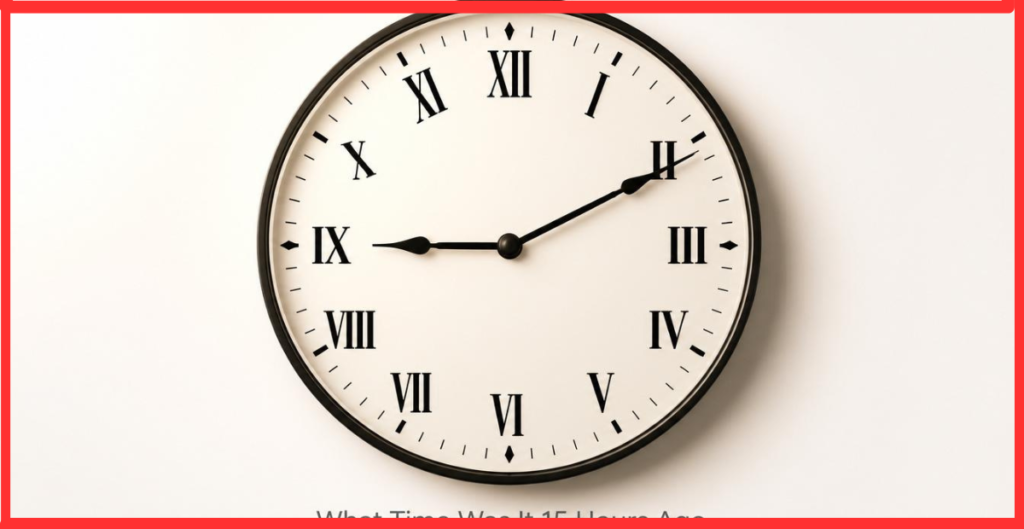
The simplest answer is this: take your current time and subtract 15 hours.
For example:
- If the current time is 10:00 AM, then 15 hours ago was 7:00 PM on the previous day.
- If it’s 6:30 PM right now, then 15 hours earlier was 3:30 AM on the same calendar day.
- If the current time is 2:00 AM, subtracting 15 hours takes you back to 11:00 AM yesterday.
This process is called hour subtraction, a basic form of time arithmetic and date-time calculation.
Many people search phrases like:
- what time was it 15 hours ago
- what was 15 hours ago
- 15 hours before now
- current time minus 15 hours
- what was the exact time 15 hours ago
All these searches aim to perform the same operation: finding a point in the past through reverse time calculation.
Understanding the Basics of Time Calculation
Humans invented clocks to organize chaos, yet we still get confused by them. Funny, isn’t it?
A proper time calculation follows a straightforward principle:
Past Time = Current Time − Time Interval
In this case:
Past Time = Current Time − 15 Hours
This method is also known as:
- Time subtraction
- Clock calculation
- Chronological calculation
- Past time calculation
- Time interval computation
Suppose your phone displays 8:45 PM.
Subtract 15 hours:
- Subtract 12 hours → 8:45 AM
- Subtract remaining 3 hours → 5:45 AM
Result: 5:45 AM on the same day.
Simple? Kinda. But things get slightly quirky when calculations cross midnight.
What Time Was It 15 Hours Ago in Pakistan?
People often specifically search “what time was it 15 hours ago in Pakistan” or “GMT+5 time Pakistan time calculation.”
Pakistan follows Pakistan Standard Time (PKT), which operates at GMT+5 year-round.
If your Pakistan time right now is:
- 11:00 PM PKT → 15 hours ago was 8:00 AM PKT.
- 7:00 AM PKT → 15 hours earlier was 4:00 PM yesterday.
- 2:15 AM PKT → subtracting 15 hours gives 11:15 AM on the previous calendar day.
Because Pakistan does not currently observe daylight saving changes, calculations in GMT+5 are relatively straightforward. Still, if you’re communicating internationally, remember that another person’s local timezone could produce a different answer.
How to Calculate 15 Hours Ago Manually

You don’t always need an app or an hours ago calculator. Sometimes a little mental math does the trick.
Here’s an easy method.
Step One: Note the Current Time
Check your:
- Digital clock
- Phone clock
- Wall clock
- Computer timestamp
Identify the exact date and time.
Step Two: Subtract 15 Hours
Perform the time subtraction formula:
Current Time − 15 Hours
Step Three: Check for Midnight Crossover
If subtraction passes midnight, adjust the date accordingly.
This concept is known as a midnight crossover or clock boundaries adjustment.
For instance:
Current time: 4:00 AM Thursday
Subtract 15 hours:
4:00 AM → 1:00 PM Wednesday
Because the subtraction crossed midnight, the answer falls on the previous day.
Honestly, midnight sneaks up like a cat in socks. You barely notice it happening.
Does 15 Hours Ago Cross Into the Previous Day?
Quite often, yes.
Whether 15 hours ago previous day calculate applies depends entirely on your starting point.
Examples
| Current Time | 15 Hours Ago | Day Change |
|---|---|---|
| 11:00 PM | 8:00 AM | Same Day |
| 8:00 PM | 5:00 AM | Same Day |
| 10:00 AM | 7:00 PM | Previous Day |
| 2:00 AM | 11:00 AM | Previous Day |
Crossing midnight is called a chronological offset.
People frequently ask:
- Is 15 hours ago yesterday?
- Does 15 hours ago cross into the previous day?
The answer: sometimes. It depends on your current day and starting hour.
What Time Was It 15 Hours Ago Today?
A search like “what time was 15 hours ago today” usually means users want an answer relative to the present moment.
Let’s imagine several scenarios.
- At 9:00 PM today → 15 hours ago was 6:00 AM today.
- At 6:00 PM today → 15 hours ago was 3:00 AM today.
- At 9:00 AM today → 15 hours ago was 6:00 PM yesterday.
Notice how morning calculations frequently spill into yesterday. That’s because the time shift crosses the midnight boundary.
This type of relative time expression is common in everyday speech.
We naturally say things like:
“I talked to her 15 hours earlier.”
or
“The package shipped 15 hours ago.”
Without realizing it, we’re constantly performing temporal reasoning.
Using a Time Calculator for Reverse Time Calculation
Technology has made reverse time lookup delightfully easy.
A time calculator, past time calculator, or reverse time calculator instantly determines earlier times.
Popular tools usually ask for:
- Current date
- Current clock time
- Number of hours to subtract
The software then performs:
- Time normalization
- Date calculation
- Time formatting
- Chronological order adjustment
These tools are especially useful for:
- Work shifts
- Payroll logs
- Travel schedules
- Medical tracking
- Project management
- Sleep monitoring
Sometimes brains are tired, and calculators are less dramatic than humans. That’s perfectly okay.
The Mathematics Behind Clock Arithmetic
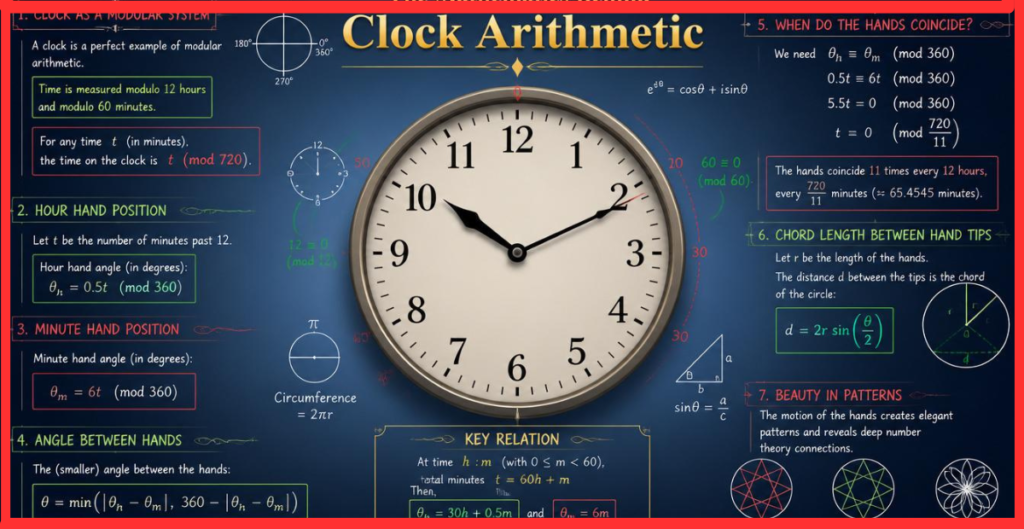
The science of clock arithmetic is surprisingly elegant.
Standard clocks use cyclical systems.
In a 12-Hour Clock
Time repeats every 12 hours.
Examples:
- 8 AM
- 8 PM
Because of repetition, AM/PM conversion becomes important.
In a 24-Hour Clock
Military and international systems often use:
- 08:00
- 20:00
The 24-hour clock eliminates ambiguity.
For instance:
20:00 − 15 hours = 05:00
Meanwhile, on a 12-hour clock, you’d convert:
8:00 PM − 15 hours = 5:00 AM
This entire process falls under time computation and time conversion.
Understanding Time Zones and Local Time
Imagine sending an email from Lahore to London.
You calculate 15 hours ago exact time in Pakistan, but your colleague lives elsewhere.
Suddenly, time zone conversion matters.
Important concepts include:
- Local time
- Time zone
- GMT+5
- Geographic time calculation
- Time offset
For example:
Pakistan: GMT+5
New York: GMT−4 or GMT−5 depending on season.
Thus, 15 hours ago in Pakistan won’t necessarily match 15 hours ago in New York.
Always verify the recipient’s local timezone when scheduling meetings or referencing past events.
Human Psychology and the Strange Feeling of Time
Have you noticed that 15 hours can feel enormous or tiny depending on circumstances?
Psychologists call this time perception.
A sleepless night can feel endless.
A joyful reunion can disappear in what feels like seconds.
Our brains process duration through:
- Memory
- Human cognition
- Emotional intensity
- Attention levels
As neuroscientists often observe, humans don’t truly experience time directly. We experience events, then reconstruct duration afterward.
Grandmother used to say, “A happy house shortens the clock.” Odd phrase, perhaps, but there is truth in it.
This intersection between human psychology, reflection, and memory recall explains why many people struggle to estimate time elapsed accurately.
Time Tracking in Daily Life
Accurate time tracking affects everyday routines more than we realise.
Examples include:
Sleep Schedule
If you slept at 10 PM and wake at 1 PM, you may wonder what happened 15 hours earlier to understand your sleep cycle.
Productivity
Workers frequently perform hours subtraction calculator tasks when documenting shifts.
Daily Routine
Understanding:
- Morning routine
- Afternoon schedule
- Evening routine
- Tea time
- Night activities
helps establish healthier habits.
Tracking daily schedules creates greater time awareness, even if life occasionally ignores our carefully prepared planners.
Converting 15 Hours Into Other Time Units
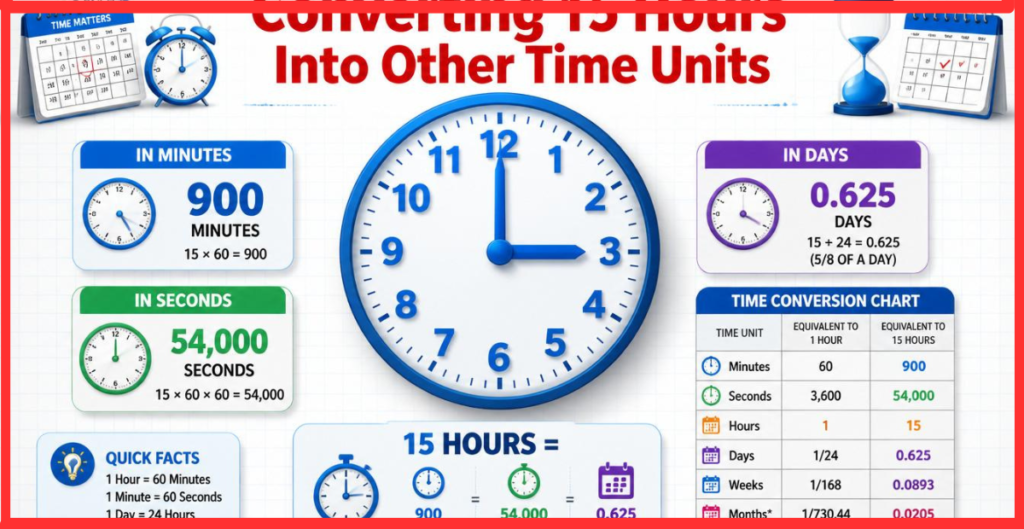
Sometimes people ask:
How many minutes are in 15 hours?
Answer:
15 × 60 = 900 minutes
This is called minutes to hours conversion.
How many seconds are in 15 hours?
15 × 3,600 = 54,000 seconds
This represents seconds to hours conversion.
How many milliseconds are in 15 hours?
15 × 3,600,000 = 54,000,000 milliseconds
That’s a lot of tiny ticking moments.
Conversions:
- 15 Hours = 900 Minutes
- 15 Hours = 54,000 Seconds
- 15 Hours = 54,000,000 Milliseconds
These calculations support:
- Time unit conversion
- Milliseconds conversion
- Time duration calculator functions
Real-Life Examples of 15 Hours Ago
A few practical examples make things clearer.
- You boarded a flight at 9 PM. It’s now noon. The departure occurred approximately 15 hours earlier.
- Your smartwatch records a workout 15 hours ago. Calculating the exact timestamp helps track recovery.
- A colleague says, “I emailed you 15 hours ago.” Using a time difference calculator confirms when the message arrived.
- Parents caring for newborns often count feeding intervals backward through time tracking, although admittedly sleep deprivation makes every clock look suspicious.
Frequently Asked Questions
What time was it 15 hours ago?
Subtract 15 hours from the current local time. The result may fall on the same day or the previous day.
What was 15 hours ago?
It refers to the exact point in time occurring 15 hours before the present moment.
When was 15 hours ago from now?
Determine the present clock time, then perform hour subtraction by 15.
How long ago was 15 hours ago?
It was exactly 15 hours, or 900 minutes, in the past.
How do I calculate 15 hours ago?
Use:
Current Time − 15 Hours = Past Time
Is 15 hours ago yesterday?
Sometimes. If subtraction crosses midnight, the result belongs to yesterday.
How many minutes is 15 hours?
There are 900 minutes in 15 hours.
How many seconds are in 15 hours?
There are 54,000 seconds.
How many milliseconds are in 15 hours?
There are 54 million milliseconds.
How do time zones affect 15 hours ago?
Different regions have different local time settings, so the answer varies by location.
What is the exact time 15 hours before now?
Use a time ago calculator, hours ago calculator, or manually subtract 15 hours from your current clock reading.
Frequently Asked Question
15 hours ago was what time
15 hours ago was simply the current time minus 15 hours. If subtracting 15 hours crosses midnight, the result falls on the previous day; you can use any time calculator or hours ago calculator to find the exact date and time.\
Read this blog https://wordzenl.com/15-hours-ago-was-what-time/
Final Thoughts
Asking “What Time Was It 15 Hours Ago?” may seem like a simple question, yet it opens a surprisingly fascinating window into timekeeping, human memory, routines, and even psychology.
Whether you’re performing date calculation, checking a message timestamp, reconstructing yesterday’s events, or simply satisfying curiosity, understanding time arithmetic empowers you to navigate life a little more confidently.
Next time you wonder what time was 15 hours ago, remember: look at your current clock, subtract 15 hours, adjust for midnight if necessary, and consider your time zone.
And while you’re at it, perhaps pause for a second. Time moves quietly. We rarely hear it walking, but somehow it always arrives exactly where it’s supposed to.