

There are odd little moments in life when time suddenly becomes slippery. You wake up from a nap that lasted suspiciously longer than intended, glance at the ceiling fan spinning like a confused philosopher, and wonder, wait…
what time was it 6 hours ago? Maybe you’re tracking a medication schedule, checking when an online order was placed, remembering a phone call, or simply untangling a memory that refuses to sit still.
Time does that, doesn’t it? It folds itself into our days like crumpled notes left inside coat pockets. A grandmother once told me, “Hours disappear faster once children enter the house.”
She wasn’t wrong. One minute it’s breakfast, the next somehow it’s evening and nobody remembers where the afternoon wandered off too.
Understanding What Time Was It 6 Hours Ago is more than simple curiosity. It involves time calculation, relative time, and even the fascinating way humans perceive passing hours.
Whether you’re using mental math, digital calculators, or simply staring at your kitchen clock hoping inspiration arrives, this guide explores everything about calculating six hours earlier.
| Current Time | 6 Hours Ago |
|---|---|
| 6:00 AM | 12:00 AM |
| 8:00 AM | 2:00 AM |
| 10:00 AM | 4:00 AM |
| 12:00 PM | 6:00 AM |
| 3:00 PM | 9:00 AM |
| 6:00 PM | 12:00 PM |
| 9:00 PM | 3:00 PM |
| 11:00 PM | 5:00 PM |
What Time Was It 6 Hours Ago?

To determine what time was it 6 hours ago, simply subtract six hours from the current time.
For example:
- If the current time is 8:00 PM, the time 6 hours ago was 2:00 PM.
- If it is 3:30 AM now, six hours earlier was 9:30 PM on the previous day.
- If the present clock shows 12:00 Noon, six hours earlier was 6:00 AM.
- If it’s exactly Midnight, subtracting six hours gives you 6:00 PM of the previous evening.
This process is called time subtraction or a reverse time calculation. It sounds almost fancy, but honestly it’s mostly just clock arithmetic wearing a neat hat.
The exact answer depends entirely on your local time, time zone, and current timestamp.
Understanding the Basics of Time Calculation
Human beings have been performing time arithmetic long before smartphones started doing the heavy lifting for us. Sailors, farmers, astronomers, and sleepy students all needed some way to calculate hours backward and forward.
At its core, time computation involves three basic elements:
- The present time.
- The amount of time to add or subtract.
- Recognition of possible date rollover into the previous or next day.
Imagine your digital clock displays 4:15 PM.
Subtract:
- 1 hour 3:15 PM
- 2 hours 2:15 PM
- 3 hours 1:15 PM
- 6 hours 10:15 AM
Simple enough, tho sometimes tired brains insist that mathematics has personally offended them.When the subtraction crosses Midnight, things become slightly more interesting.
Example:
Current clock time: 2:00 AM
Subtract six hours:
2:00 AM → 8:00 PM (Previous day)
This is where previous day calculation enters the picture.
What Time Was It 6 Hours Ago in GMT+5?
For people living in GMT+5, including regions in Pakistan and nearby areas, the same principles apply.
Suppose the current time GMT+5 is:
- 10:00 AM GMT+5 → 4:00 AM GMT+5 six hours earlier.
- 1:00 AM GMT+5 → 7:00 PM GMT+5 on the previous calendar date.
- 6:30 PM GMT+5 → 12:30 PM GMT+5.
When asking, “what time was it six hours ago in GMT+5?”, always begin with the exact local time conversion for your region.
Because global communication is common now, people often compare:
- GMT+5
- UTC
- Local regional time
- International business schedules
A tiny mistake in time adjustment can mean missing a meeting entirely. Nobody enjoys joining a video call six hours late. Well, maybe introverts do, a little.
Why People Frequently Search “What Time Was It 6 Hours Ago”
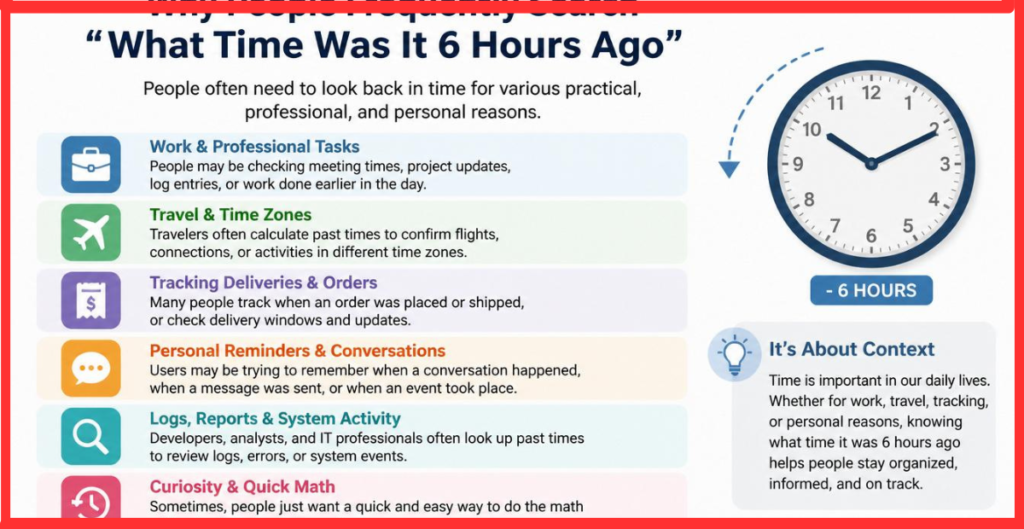
The internet receives thousands of time-based queries every single day.
Common reasons include:
- Tracking medication schedules.
- Reviewing transaction timestamps.
- Checking delivery updates.
- Verifying work shifts.
- Remembering events.
- Managing sleep cycles.
- Planning international meetings.
- Calculating fasting periods.
- Monitoring exercise sessions.
Memory isn’t always reliable. According to studies on human perception of time, people routinely misjudge durations, especially when stressed, distracted, or emotionally engaged.
You may feel a conversation happened “just a few hours ago” only to discover it occurred yesterday afternoon. Brains are weird lil things sometimes.
How to Calculate 6 Hours Ago Without Any Calculator
You do not always need an online tool. Mental math works surprisingly well.
Here’s a quick method.
Step One: Identify the Current Time
Suppose your current timestamp reads 7:45 PM.
Step Two: Subtract Six Hours
7:45 PM minus 6 hours equals 1:45 PM.
Easy.
Step Three: Check for Date Changes
If the current time is 4:00 AM:
4:00 AM – 6 hours = 10:00 PM yesterday.
Whenever subtraction passes Midnight, remember to adjust the calendar date.
Examples:
| Current Time | Six Hours Earlier |
|---|---|
| 9:00 PM | 3:00 PM |
| 7:00 AM | 1:00 AM |
| 5:00 AM | 11:00 PM (Previous Day) |
| 12:00 AM | 6:00 PM (Previous Day) |
This process represents classic clock math and hour calculation.
Tools That Help Calculate What Time Was It 6 Hours Ago
Thankfully, modern life provides plenty of digital tools.
Popular options include:
- Time calculator
- Reverse time calculator
- Hours from now calculator
- Time difference calculator
- Date and time calculator
- Online time calculator
- Time conversion tool
- World clock utilities
- UTC converters
- Inch Calculator and similar time calculators
These tools automatically account for:
- Time zone changes.
- AM/PM conversion.
- 24-hour clock formatting.
- Daylight saving adjustments.
- Date rollover.
Honestly, calculators remove much of the annoyance. There’s no medal for manually subtracting hours while half asleep at 2 AM.
AM/PM Versus 24-Hour Clock Calculations
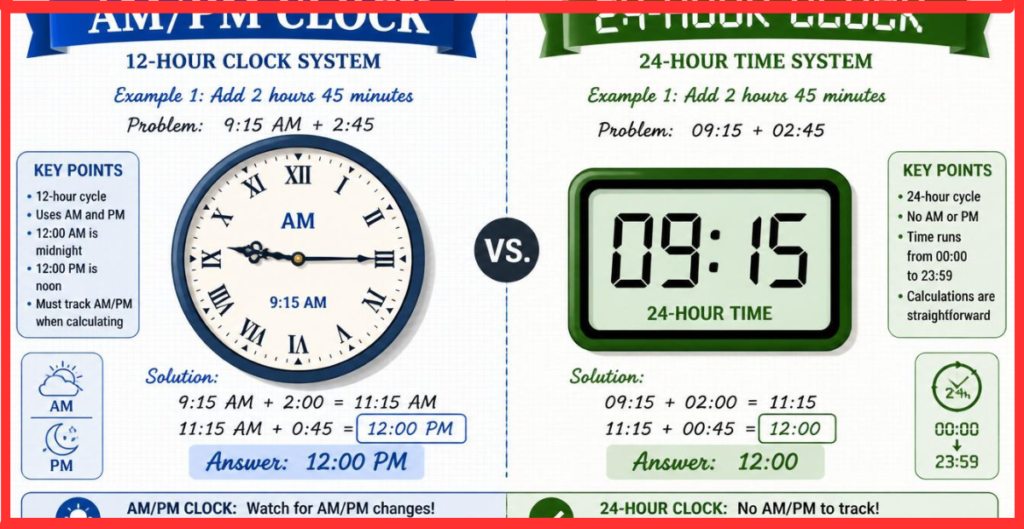
Different countries use different clock formats.
In a 12-hour clock, times appear as:
- 8:00 AM
- 3:15 PM
- 11:45 PM
The 24-hour clock displays:
- 08:00
- 15:15
- 23:45
Example:
Current time: 23:00
Subtract six hours:
23:00 – 6 = 17:00
Converted back to AM/PM:
17:00 = 5:00 PM
Understanding clock conversion prevents confusion, especially during travel or international communication.
Military personnel, healthcare professionals, and airlines frequently rely on the 24-hour clock because it reduces ambiguity.
Nobody wants surgery scheduled for the wrong 7 o’clock.
The Science Behind Human Time Perception
Strangely enough, humans are not natural clocks.
Research into human time perception shows that emotions dramatically influence our sense of duration.
Consider:
- Waiting in a hospital feels endless.
- Vacation afternoons vanish almost instantly.
- Childhood summers seemed gigantic.
- Staff meetings can somehow last three centuries.
Our internal sense of time progression shifts constantly.
Psychologists studying time awareness and memory explain that emotionally significant events are remembered differently. This often causes time confusion when people try reconstructing past events.
You might ask:
“Was that message sent six hours ago or eight?”
Without an actual timestamp, memory may fail you.
As one grandfather reportedly joked:
“After retirement, Tuesday and Thursday became basically the same day.”
A surprisingly relatable observation, honestly.
Common Mistakes During Reverse Time Calculation
Even simple time logic creates mistakes.
People often:
- Forget to switch AM to PM.
- Ignore previous day calculation.
- Confuse local time zones.
- Mix 12-hour and 24-hour formats.
- Subtract incorrectly after Midnight.
- Overlook daylight-saving adjustments.
Example error:
Current time: 2:00 AM
Incorrect answer:
8:00 AM
Correct answer:
8:00 PM on the previous day.
Always verify whether your calculation crosses Midnight.
A tiny oversight can create a massive time difference.
Examples of Exact Time Calculations
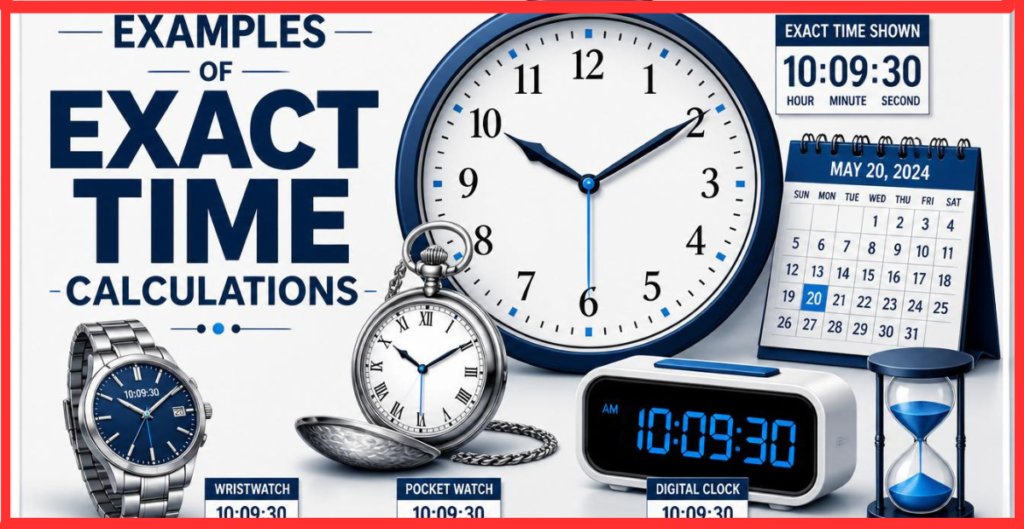
Let’s perform several exact hour calculations.
Current clock time: 11:00 PM
Six hours earlier:
11:00 PM → 5:00 PM
Current clock time: 6:30 AM
Six hours earlier:
6:30 AM → 12:30 AM
Current clock time: 4:15 AM
Six hours earlier:
10:15 PM previous day
Current clock time: Noon
Six hours earlier:
6:00 AM
Current clock time: Midnight
Six hours earlier:
6:00 PM previous day
These examples demonstrate practical time normalization and time representation.
Related Time Queries People Also Search For
Once people search what time was it 6 hours ago, they often continue exploring related questions.
Popular searches include:
- What time was it 5 hours ago?
- What time was it 7 hours ago?
- What time was it 8 hours ago?
- What time was it 12 hours ago?
- What was yesterday at this time?
- Current local time.
- Time zone converter.
- Hours between two times.
- Add or subtract time calculator.
- Calculate elapsed time.
- GMT time calculator.
- UTC time converter.
These represent broader concepts of temporal reasoning, chronological reasoning, and event timing.
Humans naturally organize life through sequences. We remember birthdays, deadlines, meals, conversations, and milestones using temporal references.
Time, in a way, is the invisible bookshelf where memories sit.
How Time Calculators Simplify Everyday Life
Modern time calculation tools help people in countless situations.
Professionals use them for:
- Payroll processing.
- Shift scheduling.
- Attendance records.
- Project timelines.
Students use them for:
- Study sessions.
- Exam preparation.
- Assignment planning.
Families use them for:
- Medication reminders.
- Feeding schedules.
- Sleep tracking.
Travelers depend upon:
- World clocks.
- International conversions.
- Flight schedules.
Without digital assistance, global coordination would become a slightly beautiful chaos.
Creative Ways to Remember Past Times

If you frequently struggle with remembering exact times, these methods may help:
- Keep digital notes with timestamps.
- Use smartphone reminders.
- Save screenshots of important conversations.
- Maintain a daily journal.
- Use calendar applications for events.
- Record appointments immediately.
Some people even create quirky memory anchors.
For example:
“I called Mum right after sunset.”
Or:
“The delivery arrived just before lunch.”
Linking events with routines improves time tracking and time reference accuracy.\
Read this blog https://hynoval.com/how-is-long-7-inches/
Final Thoughts: Time Is More Human Than Mathematical
Answering What Time Was It 6 Hours Ago may seem like simple arithmetic, yet it touches something surprisingly human. We use time not merely to schedule meetings or set alarms, but to place memories, emotions, and experiences into order.
Whether you rely on mental math, an online time calculator, a reverse clock calculator, or your trusty smartphone, understanding how to calculate six hours earlier can save confusion and improve daily planning.
The next time you wonder, “what was 6 hours ago from now?”, remember:
Start with the current time, subtract six hours, check for any date rollover, and confirm your time zone.
And if your brain still refuses cooperation, well, that happens to all of us now an then.
Do you regularly use time calculators, or do you still trust old-fashioned clock math? Share your experiences, favorite tools, or memorable time-mixup stories in the comments. Someone else is probably equally confused by clocks today.